Everyday Appliances · Practical guide
Why Your Countertop Ice Melts Back Into the Machine
In this guide Jump to a section
- Find the storage promise in the manual
- Follow the water through the machine
- Separate production from a full-bin snapshot
- Check the surrounding space
- Plan ice around the time you need it
- Recognize a meaningful change
- Avoid three misleading fixes
- Keep a short support-ready record
- Match the tool to the occasion
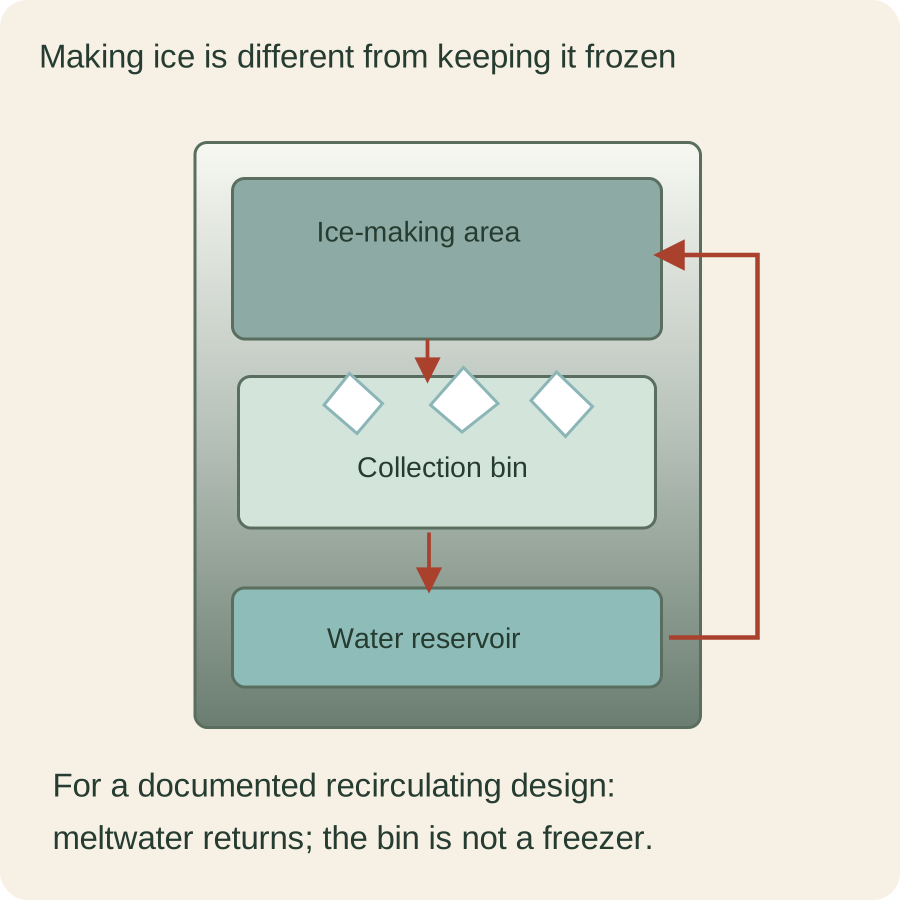
Ice melting in a countertop ice maker is not automatically a malfunction. Some machines collect ice in a bin that is not a freezer, allowing melted water to return to the reservoir while the machine makes more ice.
First find out how your exact model stores its output. That one distinction helps you decide whether you are seeing expected operation, a placement problem, or a change worth asking support about.
Find the storage promise in the manual
Look for the manual’s explanation of the ice bin and the water system. Separate the machine’s ability to make ice from any claim that it preserves a finished batch in a frozen state.
GE’s Opal support guidance states that its bin does not keep the ice frozen and that melted ice water returns to the reservoir. That is an example of a documented recirculating design, not a description you should automatically apply to every countertop model.
Look for model-specific statements about keeping ice, transferring it, and stopping production. If the listing’s short description seems broader than the actual instructions, ask the manufacturer to resolve that difference before treating it as a fault.
Keep the manual’s language in your notes rather than translating a production rate into freezer capacity. A machine that can make a stated amount over time does not necessarily store that same amount for later use.

Follow the water through the machine
Picture three separate places: the water supply or reservoir, the ice-making area, and the collection bin. A recirculating design can move water through those places more than once instead of preserving every piece of ice indefinitely.
Observe the parts you are allowed to view without removing guards or dismantling the unit. You are trying to understand the normal path, not perform an internal inspection while the appliance is running.
The return of melted water can make a bin look less full when you return later. That observation alone does not tell you that water has leaked out of the appliance or that the entire batch has been wasted.
If you see water where the manual says it should not be, treat that as a separate observation. Record its location and follow the maker’s troubleshooting instructions instead of dismissing every puddle as ordinary melting.
Separate production from a full-bin snapshot
Choose a normal period when you can observe the machine in its intended setup. Note when you start, whether you remove ice, and what the bin looks like at a few reasonable intervals.
Do not compare an unattended overnight bin with a headline production figure as if the two measurements describe the same thing. Production can occur while previously made ice melts, and removing ice changes the picture again.
Use the manufacturer’s stated testing conditions when interpreting a published output claim. If those conditions are not available, keep your observation as a description of your kitchen rather than declaring that you have reproduced a laboratory test.
A simple note such as “some ice present at breakfast, more after lunch, two glasses removed” is more useful than a precise-looking estimate you cannot support. Keep the observations honest enough that support can work with them.
Check the surrounding space
GE’s Opal guidance identifies a warm room or an enclosed position as factors that can reduce ice production. Check your own model’s location requirements and operating conditions before assuming all changes come from the ice itself.
Look for a blocked vent, a newly crowded counter, or another change to the permitted surroundings. Follow the specified clearance for the exact model rather than borrowing a distance from a different machine.
Do not attempt to improve performance by adding a homemade enclosure or insulating the appliance. A machine’s cooling and ventilation requirements remain part of its operation even when the collection bin is not a freezer.
Consider changes through the day as well as the place you first chose. A position that seems comfortable in the morning may be warmer when nearby cooking equipment is in use, subject to the maker’s placement rules.
Plan ice around the time you need it
If your machine is designed for ready access rather than frozen storage, treat the bin as part of today’s serving routine. Check its permitted operating method and plan the production period around when you actually want ice.
For a few drinks, immediate access may matter more than preserving a large batch. For a gathering, write down when you will need ice and whether a separate freezer-storage plan is part of your setup.
Follow the appliance and food-storage instructions for transferring ice, using a suitable clean container and handling method. A countertop machine’s bin should not be assumed to have the same storage role as your freezer.
Do not promise a guest a particular texture or an exact amount from a schedule you have never observed. Your own ordinary-use notes can inform planning without turning into an unsupported product performance claim.
Recognize a meaningful change
Compare today’s behavior with the manual and with your own prior observations under similar conditions. A machine that has always recirculated some meltwater is different from one that suddenly produces no usable ice at all.
Record any displayed message, unusual sound, unexpected water location, or change in cycle behavior. Keep those details separate so support does not have to infer them from a general description that the ice disappeared.
Follow the documented troubleshooting sequence for your exact model. Avoid adjusting internal sensors, bypassing switches, or improvising repairs because another owner’s machine looked similar in a video.
If the instructions call for stopping use or seeking service, follow that direction. Understanding normal melting should help you make a clearer decision, not encourage you to overlook an unrelated electrical or water problem.
Avoid three misleading fixes
Do not add more water than the maker permits in an attempt to force a larger batch. A fill limit describes the intended operating setup, and changing it does not establish that the storage bin will stay colder.
Do not block openings because you suspect outside air is melting the ice. A vent may serve a different part of the appliance, and its function is not something you can determine from the bin’s appearance alone.
Do not add unapproved accessories or substances to the water path. Use only the water, cleaning procedures, and components the manufacturer specifies for that machine.
If the normal design does not meet your need for stored frozen ice, reconsider the appliance category or your serving routine. A documented limitation is a better basis for that decision than repeatedly trying to turn the bin into a freezer.
Keep a short support-ready record
Save the model number, manual’s storage explanation, permitted setup, and your observations in one place. Include clear photographs of any unexpected external water or displayed message without opening restricted areas.
State the question you want answered: whether the observed melt-and-return behavior is expected, whether the production change needs troubleshooting, or whether the model suits your serving plan. Those are related but distinct questions.
You should finish with a realistic expectation for the machine you own. When the manual describes recirculation, some melting can belong to normal operation; the useful next step is to plan around that design and investigate changes using the exact model’s guidance.
Match the tool to the occasion
For a dinner with friends, separate the amount you hope to serve from the amount you can actually store frozen. Write down the container space and timing you have available instead of assuming an attended serving plan and an unattended overnight plan are interchangeable.
If you decide to transfer ice, follow the relevant storage and handling instructions and leave the machine’s own water system unchanged. The useful adjustment is to your serving plan, with the appliance still operating in the configuration its maker supports.
Keep a second plan for an occasion that depends on more ice than you have previously observed. That is ordinary preparation, not evidence that the machine has failed its documented purpose.
Sources & research notes
Documentation checked October 22, 2026. Practical examples are original planning exercises; product recommendations compare documented features.