Kitchen Fit · Practical guide
Which Kitchen Tools Deserve Your Limited Counter Space?
In this guide Jump to a section
- Protect one working patch first
- Watch a normal week instead of your ideal week
- Compare the move with the job
- Assign a counter job to every permanent resident
- Count the space around the object
- Run a temporary trial before buying storage
- Keep use and cleanup in the same decision
- Make a simple keep-out list
- Allow for changing routines
A kitchen tool deserves permanent counter space when leaving it out makes your ordinary meals easier enough to justify what it displaces. You can make that decision without buying an organizer or deciding that every visible appliance is clutter.
Start with the space you need to prepare food, then let the tools compete for what remains. The goal is a counter that supports your routine, not a photograph that stays tidy only because nobody cooks there.
Protect one working patch first
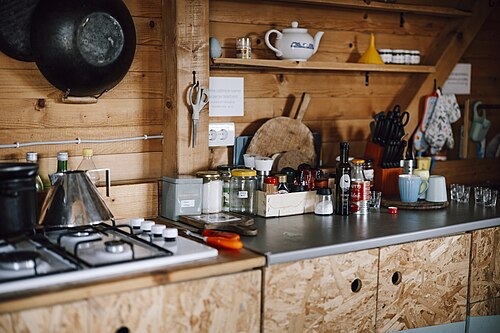
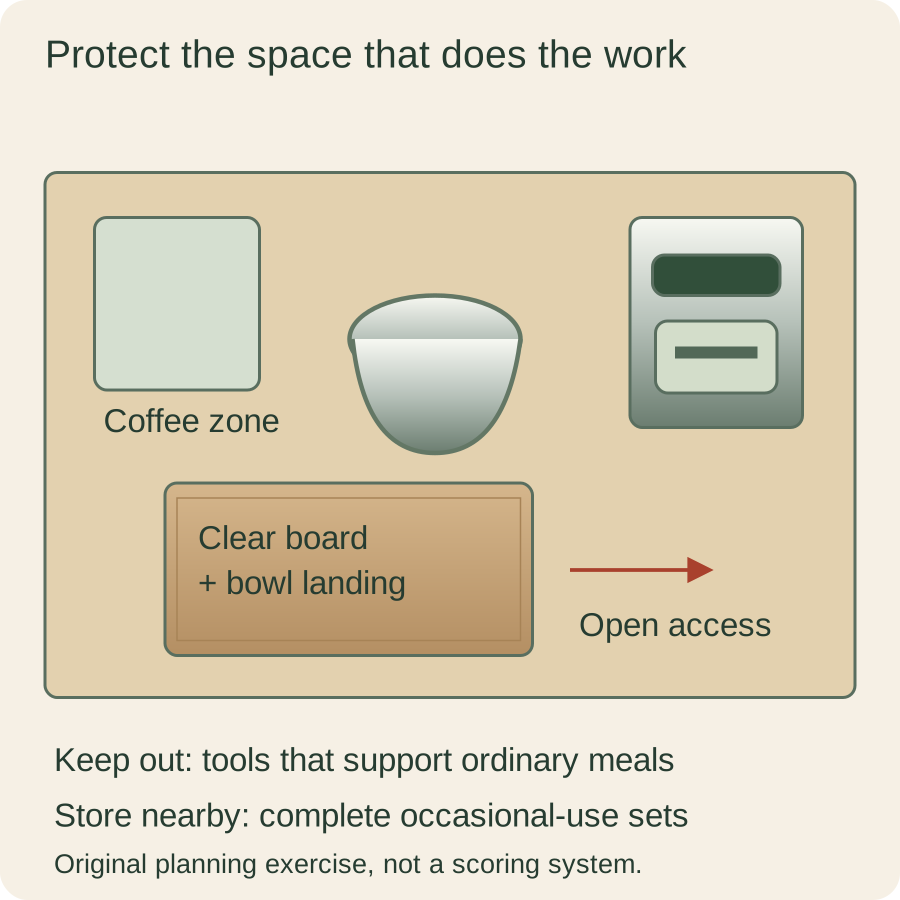
Put your usual cutting board on the counter along with a bowl and a plate. Choose the arrangement you naturally use when preparing dinner, rather than the smallest arrangement you can tolerate for a minute.
Mark that patch with a removable note or a temporary paper outline. Treat it as working space during the rest of this exercise so you do not accidentally allocate every inch to things that sit still.
Include the little movements around the board: setting down a knife, turning a bowl, and moving prepared ingredients toward the stove. A board-shaped gap is less useful when you cannot comfortably use the board in it.
If two people regularly cook together, try the setup together before proceeding. You may need a second clear landing area more than you need another appliance waiting beside the first one.

Watch a normal week instead of your ideal week
For several ordinary days, notice which tools you use and how often you move them. Record the task as well as the appliance so your note says “blend breakfast” rather than only naming the blender.
Keep occasional projects on a separate list. A mixer used for a monthly baking session can be valuable without needing to occupy your most convenient preparation corner every day.
Notice tools you leave out but rarely touch. They may be there because they are difficult to store, because they match the room, or simply because nobody has reconsidered their location recently.
Do not judge those reasons yet; identifying them is enough. A familiar object can occupy an expensive patch of counter without providing a benefit you would deliberately choose today.
If the week was unusually quiet or busy, say so in your notes. You want a representative picture of your kitchen, not a reason to reorganize everything around one holiday or one evening of takeout.
Compare the move with the job
For each tool, rehearse taking it out, setting it up, using it, cleaning it, and putting it away. Pay attention to the point that makes you most likely to skip the job or leave the machine out afterward.
A small tool can still be annoying to store if its parts scatter across several drawers. A larger one can be manageable when its body and attachments have a clear, reachable home beside the working area.
Write down the actual obstacle rather than giving the appliance a vague “inconvenient” label. “Need to unload three bowls to reach the lid” suggests a storage change; “too heavy to lift comfortably” suggests a different placement decision.
Separate a storage problem from a reason for permanent display. Sometimes the right fix is moving the appliance’s accessories together, not surrendering the only open counter because the current cupboard is frustrating.
Assign a counter job to every permanent resident
Give each item you want to keep out a short job description. “Morning coffee without unpacking equipment” is specific enough to compare against the space and cleaning effort the station requires.
Consider whether two items are doing almost the same job for your actual meals. You might prefer keeping one accessible and storing the other for the occasions when its different capability matters.
Do not assume a multipurpose appliance automatically replaces every separate tool. Check its supported uses and attachments, then compare the preparation and cleanup involved for the small jobs you really do.
A manual tool can earn a prime position too. A frequently used cutting board or kettle may support more ordinary meals than a larger machine with a longer list of advertised functions.
Keep personal convenience in the comparison. If a tool lets you prepare a meal comfortably that would otherwise be difficult, its value is not captured by how many times another household happens to use it.
Count the space around the object
Measure the appliance as you use it, not just as it appears when switched off. Include open lids, pulled-out drawers, removable tanks, and the place you need for a bowl or hot accessory.
Read the exact manual for required placement and ventilation rather than packing machines tightly together. Manufacturer clearances are part of the working layout, even when a product looks compact enough to tuck into a gap.
Think about the power route and cleaning access as well. If using one appliance means shifting two others or stretching a cord through your work area, its real space claim extends beyond its base.
Check whether the machine blocks something else you use more often. A toaster that prevents a cupboard door from opening fully may create a small inconvenience every time you reach for a glass.
Run a temporary trial before buying storage
Choose one rarely used counter item and give it a safe temporary storage home that follows its manual. Try your normal meals with the freed space before deciding whether the change is worth keeping.
During the trial, record whether you miss the tool and what you do instead. You might find that you happily take it out once, or that moving it becomes irritating enough to justify bringing it back.
Keep the experiment reversible. You are testing a layout, not proving that owning fewer tools is always better or forcing yourself to work around a decision that clearly makes cooking harder.
Try a second small change only after you understand the first one. Moving everything at once can make it hard to tell which adjustment helped and which simply made the kitchen unfamiliar.
Keep use and cleanup in the same decision
A permanent station collects crumbs, splashes, or dust around its base, depending on what you do there. Ask whether you can clean underneath and around the item without turning a small wipe-down into a lifting project.
Give loose accessories a deliberate home rather than letting them spread into the preparation patch you protected. A machine’s usefulness does not require its entire attachment collection to remain visible beside it.
Look at where finished dishes wait and where groceries land when you arrive home. Those temporary activities deserve room too, even though they do not have their own appliance or attractive storage container.
If a counter arrangement works in the morning but fails during dinner cleanup, treat that as a real limitation. Your kitchen has to accommodate more than one snapshot of the day.
Make a simple keep-out list
Finish with a short list of the tools that stay out and the jobs they support. Add a note about where the stored tools live so you do not rebuild the same clutter through forgotten locations.
Revisit the list when your cooking routine changes or you consider another purchase. A clear description of what already earns its space makes it much easier to decide whether the next tool solves a real problem.
You do not need to achieve a perfectly empty counter. You need enough usable room, accessible equipment, and a routine you can maintain on an ordinary busy evening.
Allow for changing routines
Your counter arrangement can change with the season or with the way you cook. A kettle used throughout winter and a machine reserved for summer gatherings do not need to hold the same place all year.
Keep a simple alternative layout for the change you actually make, rather than creating an elaborate system for every possible occasion. A photograph and one labeled storage home may be enough to make the switch straightforward.
Also reconsider convenience when your household’s needs change. A tool that saves difficult lifting or reduces a preparation step can deserve more accessible space even if it does not appear in every meal.
Use your own experience of the task as the deciding evidence. The point of the exercise is to make cooking easier in this kitchen, so a layout that looks less symmetrical can still be the more useful result.
Sources & research notes
Documentation checked October 22, 2026. Practical examples are original planning exercises; product recommendations compare documented features.