Cookware Skills · Practical guide
How to Store Heavy Cookware Without Scratching It
In this guide Jump to a section
- Start with your three usual pans
- Choose a comfortable lifting level
- Make stacks shallow and deliberate
- Give lids their own order
- Check dryness before closing the door
- Consider upright storage carefully
- Rehearse a whole meal’s retrieval
- Use a simple maintenance check
- Check the handle path as well as the shelf
Store heavy cookware so you can remove the pan you need without dragging one cooking surface across another. A useful arrangement protects finishes, keeps lids understandable, and gives the heaviest pieces a comfortable lifting route.
You can improve a single crowded cupboard before buying a rack. Start with the pans you use most often and make the storage method fit their shapes, materials, and care instructions.
Start with your three usual pans
Choose the pans that appear most often in your normal meals and place them together while they are cool, clean, and dry. Look at their full dimensions, including long handles and helper handles, rather than comparing only their rim sizes.
Identify which surfaces you are trying to protect. A coated interior, an enameled edge, a polished exterior, and a seasoned cast-iron surface may need different handling and care.
Read the maker’s storage and cleaning guidance for each material before putting everything into the same nesting stack. A tidy arrangement is less useful if it traps moisture or puts an unsuitable contact point against a delicate finish.
Keep the pans’ importance in view as you work. An occasional oversized pot should not make retrieving your everyday skillet a complicated lifting exercise every evening.

Choose a comfortable lifting level
Try lifting each empty pan from the proposed shelf and setting it on the counter. Use the intended handles and a route you can manage without twisting around a cupboard door.
If the pan is already awkward when empty, putting it high above your comfortable reach is unlikely to improve the move. A reachable lower location can be more useful than a visually impressive display.
Consider the shelf and any accessory’s load limits before grouping several heavy pieces together. Follow the cabinet and organizer manufacturers’ installation and loading instructions rather than judging strength by how solid the shelf looks.
Do not depend on catching a shifting lid while supporting a heavy pot. Store the assembly in a way that lets you grasp the pan securely without balancing loose parts during the move.
Make stacks shallow and deliberate
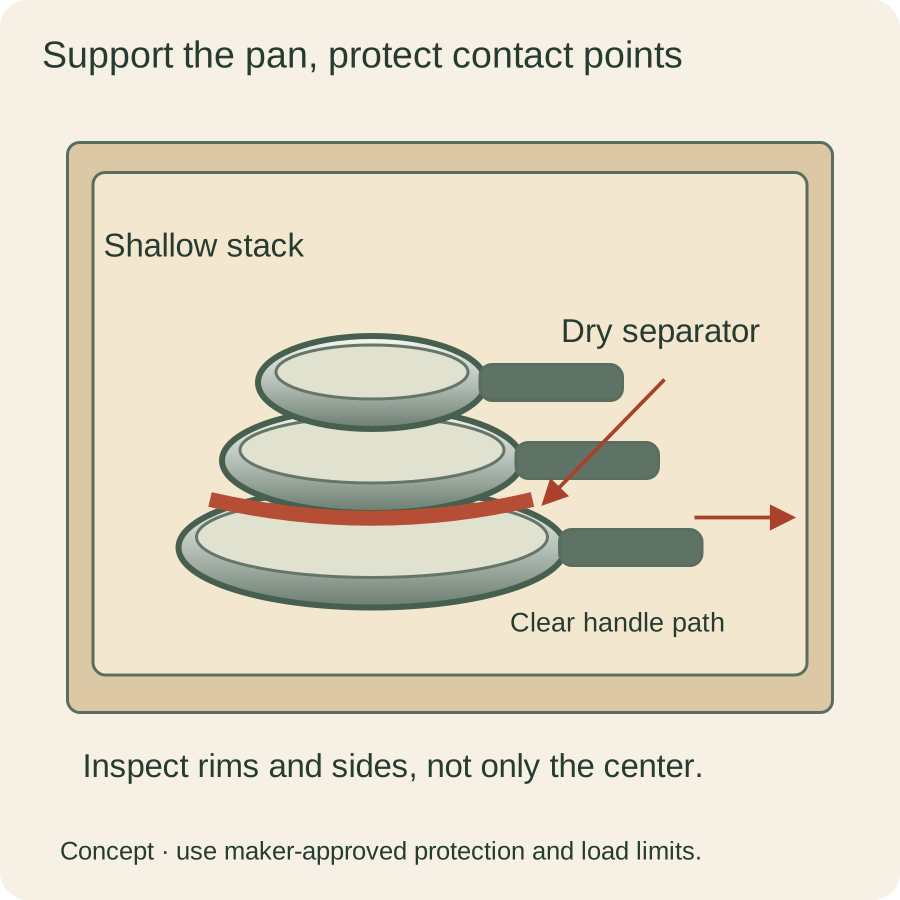
If nesting is permitted for your cookware, choose a small stack you can separate comfortably. The pan you use most often should not require you to lift a whole collection before you can reach it.
Insert an appropriate clean, dry protector where the maker recommends protection between surfaces. Check that the protector actually separates the points that touch, including rims or projecting hardware.
A small separator in the center may leave the sides of a smaller pan rubbing against the larger pan’s interior. Look at the complete contact pattern rather than assuming one soft square protects every edge.
Keep grit and dried food out of the stack. Protection is most useful when both the cookware and the material between it are clean enough that you are not pressing debris against a finish.
Try removing and replacing the middle pan a few times. If it catches, tilts, or drags against its neighbor, revise the stack before calling the arrangement finished.
Give lids their own order
Pair every lid with its matching pan before deciding where lids will live. Similar diameters can hide different rim shapes, so a lid that appears to fit is not automatically the correct replacement.
A separate lid area can make a cupboard easier to use, provided each lid sits securely and you can see what it belongs to. A label or simple size grouping is often enough to avoid repeated trial fitting.
If you use a vertical organizer, check its permitted load and the space around each knob. Do not wedge a glass lid into a slot or force it against another piece just to fit one more item.
Keep frequently used lids within the same zone as their pans. Moving lids to a distant drawer may make the original cupboard look better while making the cooking task less convenient.
Check dryness before closing the door
Finish the cleaning and drying process recommended for the cookware before storing it. Do not let a tight stack become the place where damp pieces wait indefinitely for their next use.
Lodge’s cleaning guidance makes thorough drying an important part of caring for seasoned cast iron. Keep that material-specific requirement separate from assumptions about how an unrelated coated or enameled pan should be maintained.
Give recently washed lids and protectors enough room to dry according to their care instructions too. A dry pan surrounded by damp storage materials has not solved the whole storage problem.
If the cupboard has a persistent moisture issue, investigate the cause rather than adding more padding to hide it. Your cookware arrangement should not depend on ignoring a leak or an unsuitable storage environment.
Consider upright storage carefully
A vertical pan organizer can reduce the need to unstack pieces, but its slots have to suit your actual pans. Measure the thickness and projection of handles as well as the diameter of the cookware.
Check whether a heavy pan remains stable when you remove the one next to it. The arrangement should not depend on every slot being occupied to prevent something from tipping.
Leave enough room to lift a pan out without scraping its rim along a shelf or cabinet frame. A slot that holds the pan securely is not useful if the exit route is too narrow.
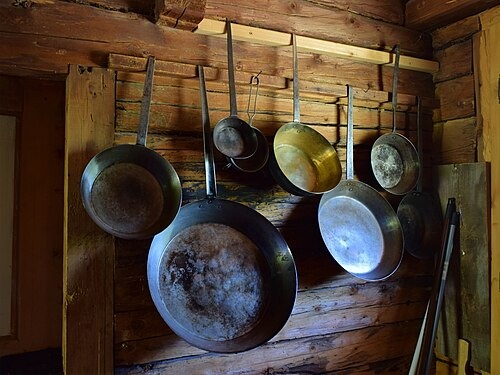
For wall-mounted or hanging storage, follow the rack’s mounting requirements and load rating. Get appropriate installation help when needed rather than treating a decorative hook as proof that a heavy collection can hang there safely.
Rehearse a whole meal’s retrieval
Take out the combination you normally use for dinner, such as a skillet and saucepan, with their lids. Notice whether removing one blocks the other or leaves the cupboard in a state you cannot easily restore.
Set the pans down where you would normally prepare to cook. If the route requires placing one temporarily on the floor or balancing it beside the sink, adjust the storage position.
Repeat the exercise in reverse after everything is cool and ready to store. Putting cookware away can reveal a different obstacle from taking it out, especially when a lid organizer or stacked protector needs careful positioning.
Invite another household member to try the arrangement without a long explanation. Their questions can reveal a lid pairing or stacking order that is obvious only because you designed it.
Use a simple maintenance check
As you return each pan, glance at the surfaces and contact points that the storage arrangement affects. Look for rubbing, trapped debris, or a protector that has shifted away from the place it was intended to cover.
Change the arrangement if you find a repeated problem rather than accepting new marks as inevitable. A different order, a separate lid position, or a shallower stack may solve more than buying another protective insert.
Recheck the layout when you add a new pan. Extra weight and a different handle shape can change how a previously workable shelf behaves, so do not simply squeeze the new piece into the last remaining gap.
Your storage system does not need to resemble a showroom. It needs to let you handle the cookware comfortably, preserve the care each material requires, and start dinner without a cupboard full of awkward negotiations.
Check the handle path as well as the shelf
Open the cupboard to its normal angle and follow the longest handle from its resting place to the counter. Watch for the hinge, door edge, adjacent pan handles, and any lid knob that forces you to tilt the pan unexpectedly.
Try the same route with the cabinet beside it open if that is how you normally cook. A storage solution that works only with every neighboring door carefully closed may be frustrating during a real meal.
Keep handle directions consistent when that improves retrieval, but prioritize secure support over a perfectly matched appearance. The useful arrangement gives your hand a clear grip before you move the cookware’s weight.
Sources & research notes
Documentation checked October 22, 2026. Practical examples are original planning exercises; product recommendations compare documented features.