Cookware Skills · Practical guide
When to Repair, Keep, or Replace a Kitchen Tool
In this guide Jump to a section
- A decision note for the actual item
- Identify the item before deciding
- Separate appearance from function
- Stop when the instructions say to stop
- Check a replacement part before a whole appliance
- Compare the job you need today
- Use three simple options
- Avoid the sunk-cost trap in either direction
- Keep a decision record
- Ask support a question they can answer
Decide whether to keep, repair, or replace a kitchen tool by separating ordinary wear from a problem that affects safe use. Start with the exact item, its instructions, and the job you need it to do rather than treating every mark as failure.
A missing accessory may be straightforward to replace; a damaged electrical part needs a different response. A calm inventory gives you a better decision than either buying a new machine immediately or continuing to use something questionable.
A decision note for the actual item
| Observation | Next useful action | Do not infer |
|---|---|---|
| Appearance change | Compare the exact material’s care guidance | Every mark is a structural fault |
| Damaged or malfunctioning powered appliance | Follow stop-use safeguards and authorized support | An external symptom authorizes internal repair |
| Missing user-replaceable accessory | Verify the exact approved part and package | A look-alike part is compatible |
Identify the item before deciding
Find the model number, approximate purchase date, and any part numbers you can read without dismantling the tool. Photograph its label while the appliance is disconnected and safe to handle.
Describe the problem in plain observations: the handle is loose, the lid no longer closes, or the machine stops during normal use. Keep those observations separate from your guess about what is happening inside.
Check whether the item is covered by a current recall or safety notice. The US Consumer Product Safety Commission provides a searchable recalls page; compare the actual model and identifying details rather than assuming every product from a brand is included.
If a notice applies, follow its specific remedy and stop-use instructions. Do not substitute a repair idea from an unrelated product, and do not treat the absence of a search result as a general safety certification.


Separate appearance from function
Look at the tool while it is clean and cool, using the care guidance for its material. A stain, a worn label, a damaged surface, and a loose structural part are different observations even when they all make something look old.
Check whether the maker describes the specific condition as normal, cleanable, repairable, or a reason to stop using the item. Avoid carrying advice for seasoned cast iron over to enamel, nonstick coatings, or electrical appliances.
Lodge’s troubleshooting guidance, for example, discusses repairable surface conditions on seasoned cast iron. That does not mean a repair method for its seasoned surface belongs on every dark-colored pan in your cupboard.
If you cannot identify the material or condition confidently, send the maker clear photographs and the model information. A documented answer is more useful than repeatedly trying stronger cleaning products to see what happens.
Stop when the instructions say to stop
Read the safeguards before looking for a workaround. A machine that intermittently operates, has a damaged cord, or shows another prohibited condition should not remain in your meal routine while you experiment with it.
The Bonavita Enthusiast manual directs users to authorized service for examination or repair of a damaged or malfunctioning appliance. Its instruction is a useful example of why an external symptom does not authorize opening an appliance’s housing.
Do not tape over damage, defeat a switch, or improvise a replacement electrical component. Arrange the evaluation or service the manufacturer recommends, using another suitable tool while the question is unresolved.
Keep the questionable item separate enough that someone else does not use it by mistake. A short note explaining that it is awaiting advice is clearer than silently moving it to the back of a cupboard.
Check a replacement part before a whole appliance
If the maker supports replacing the affected part, find its exact compatibility list and part number. A bowl or lid that looks the right size can still have different connections, seals, or operating requirements.
Compare what the package includes. A replacement assembly may contain several pieces, while a similarly named listing may include only one component you would still have to fit to other parts.
Include shipping, any required professional fitting, and the time you expect to wait. This gives you a fairer comparison with replacement than comparing the price of a tiny component with the full price of a new machine.
Check the return conditions before ordering a part whose compatibility remains uncertain. Do not buy several look-alike options and assume the one that physically attaches is necessarily approved for operation.
Compare the job you need today
Ask whether the tool still suits the way you cook. You may be repairing something that works as designed but no longer handles the quantities, storage space, or physical tasks you need.
Write down the main job and the problem you want a replacement to solve. “The jar is difficult to clean” is a clearer buying brief than “something newer,” and it helps you avoid replacing one inconvenience with another.
Keep a tool that performs its job reliably within its instructions even if a newer model has more settings. Extra controls are useful only when they support a task you actually want to do.
Likewise, do not keep an unsuitable tool solely because it can technically be repaired. A repair decision includes its future usefulness, not just the satisfaction of making it operate again.
Use three simple options
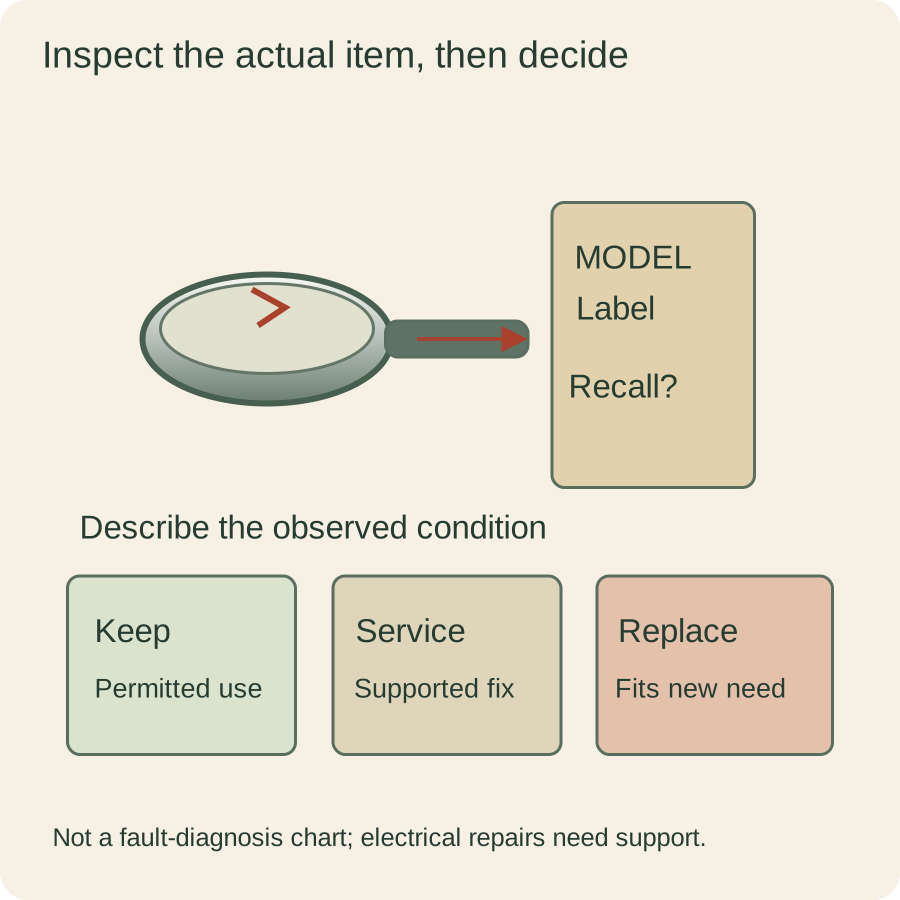
Choose “keep” when the item remains suitable, its condition is permitted by the maker, and any routine maintenance is clear. Record the care step you will actually follow rather than promising an elaborate maintenance routine you will not sustain.
Choose “evaluate or repair” when the maker supports a defined part replacement or authorized service and the item still suits your needs. Get the scope and cost before approving work so you can compare the complete option.
Choose “replace” when safe supported use cannot be restored reasonably or the tool no longer serves your routine. Keep disposal and recycling requirements in the decision instead of treating the old machine as a problem for later.
These are decision categories, not a diagnosis chart for hidden faults. When the condition requires a professional assessment, that assessment comes before choosing to keep operating the equipment.
Avoid the sunk-cost trap in either direction
What you paid years ago does not tell you whether today’s repair is sensible. Compare the money and effort still ahead with the useful service you reasonably expect from each supported option.
Do not assume that a low purchase price makes a safe replacement part unworthy of consideration. A simple supported fix can be useful when the rest of the tool works well and suits your kitchen.
Do not assume an expensive original purchase justifies every repair either. A costly machine that needs repeated attention may no longer be the easiest way to do the job you want it to do.
Use the same practical comparison for a manual tool, a pot, or a powered appliance, while keeping their safety and repair boundaries distinct. Their prices may differ, but the need for an identifiable problem and a supported response remains useful.
Keep a decision record
Save the model, observed condition, support advice, part number or service quote, and the option you chose. A short record prevents you from repeating the same search when a similar question comes up later.
If you replace the tool, carry its successful features into your shopping brief as well as the problem you want to avoid. The next purchase should support your cooking routine, not simply remove an old object from the counter.
A good decision leaves you with usable equipment and a clear reason for keeping, repairing, or replacing it. You do not need to rescue every tool or discard every worn one; you need an answer grounded in the actual item and its documented condition.
Ask support a question they can answer
Send one clear description of the condition, the full model number, and photographs of the relevant area rather than a general question about whether an old tool is still good. Ask whether continued use is permitted and what supported action addresses the condition.
If the answer names a replacement part, request its exact identifier and whether any installation work belongs with an authorized service provider. Keep that answer with your decision record so a later shopping search does not replace the maker’s compatibility advice.
When the reply does not resolve your actual observation, ask a focused follow-up before operating the appliance again. A suggestion about routine cleaning is not an answer to an unresolved electrical or structural concern.
Sources & research notes
Documentation checked October 22, 2026. Practical examples are original planning exercises; product recommendations compare documented features.