Cookware Skills · Practical guide
How to Match a Skillet Size to Your Burner and Dinner
In this guide Jump to a section
- Measure the meal you make most often
- Separate the rim measurement from the base
- Read the cooktop guidance before applying a general rule
- Check the base on the intended burner
- Try the second pan you use beside it
- Include lifting, serving, and cleanup
- Compare two sizes with the same dinner
- Compare the full length on paper
Choose a skillet by matching three things: the food you want to arrange inside it, the base that sits over your burner, and the complete pan you must lift and store. The diameter printed on the label is only one part of that decision.
A larger pan can give dinner more room, but it does not automatically suit your cooktop or your hands better. Work through the fit before you decide that the biggest skillet is the most versatile one.
Measure the meal you make most often
Think of a typical dinner rather than the largest meal you might cook once a year. Two chicken portions, a pair of sandwiches, and a pan of vegetables need different shapes of usable space.
Lay paper outlines representing that food on your current skillet while the pan is cool. Leave the arrangement as you would want it for the recipe instead of packing everything tightly just to demonstrate that it fits.
Notice whether the food sits on the flat cooking surface or climbs the sloping sides. A skillet can have a generous rim diameter while offering less flat room than you expected.
If your current meal needs two batches, identify whether that actually bothers you. An occasional second batch may be a smaller inconvenience than storing and handling a larger pan every day.


Separate the rim measurement from the base
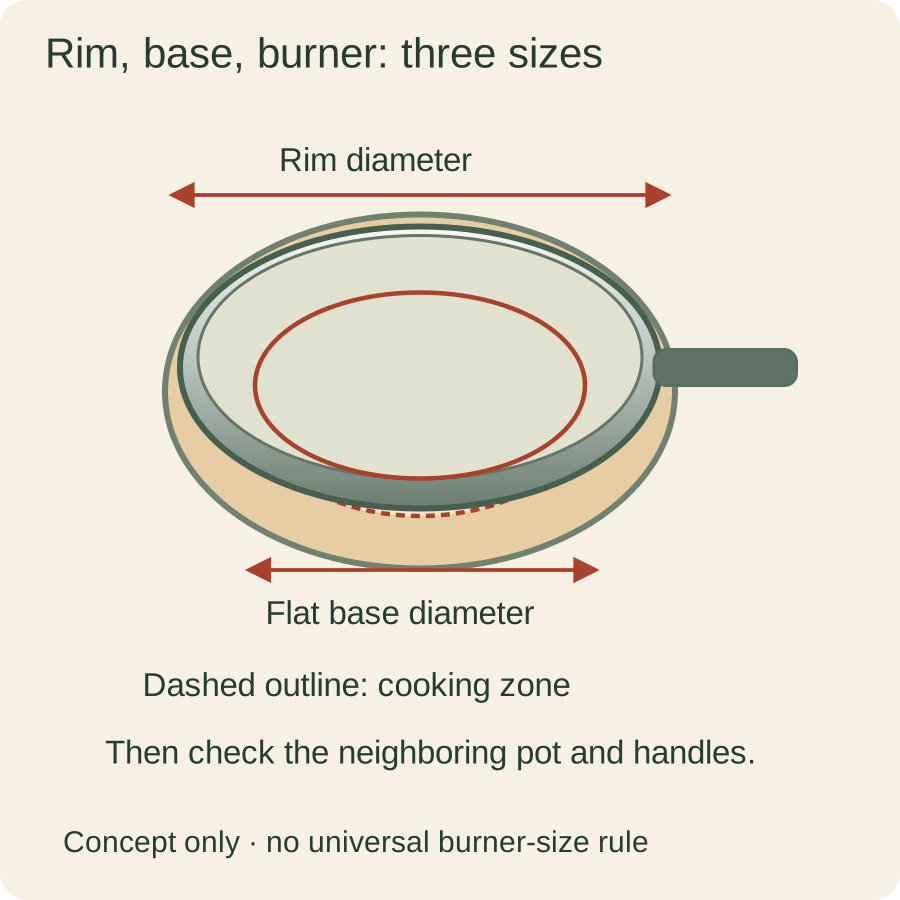
Read the manufacturer’s dimension drawing and look for what each measurement includes. The rim, flat interior floor, bottom contact area, and full length with handle can all be different numbers.
Measure your existing cool pan in the same way before comparing it with a candidate. Comparing one pan’s rim with another pan’s flat base creates a difference that may have nothing to do with their practical cooking space.
If a listing provides only one diameter, treat the missing dimensions as unresolved. A photograph may show sloping sides, but it does not give you a dependable measurement for the floor inside them.
Ask the manufacturer for the usable interior and base measurements if those details decide the purchase. Include the exact model, because a brand’s similarly sized sauté pan and skillet can have different shapes.
Read the cooktop guidance before applying a general rule
Find your cooktop model and its recommended cookware guidance, especially if you use induction or a smooth glass surface. The pan maker and stove maker can describe different sides of the same compatibility question.
GE’s gas-burner sizing guidance says the maximum pan diameter depends partly on whether you use one burner or several and on the continuous grate area. Its approximate sizing examples are not a substitute for your specific range’s instructions.
For a radiant smooth-glass cooktop, GE emphasizes flat-bottom contact and gives material-specific recommendations. That is a useful reminder that a pan can be generally suitable for cooking while still being a poor match for a particular appliance.
If you encounter conflicting general advice, follow up with the manufacturers using both exact model numbers. Do not resolve the disagreement by choosing whichever statement permits the pan you already wanted.
Check the base on the intended burner
With the cooktop off and cool, compare the pan’s base with the intended cooking zone. Check the manual’s size and placement instructions rather than assuming that matching the outside rim to a printed ring tells the whole story.
For gas, inspect the supported position on the grate and the space around neighboring burners. Keep the flame arrangement within the appliance and cookware instructions instead of treating a bigger flame as a way to make a small pan work faster.
For induction, confirm that the pan and its base size meet the cooktop’s requirements. A pan being described as induction compatible does not answer every question about a particular cooking zone’s minimum supported size.
Check whether the pan sits level and stable in its working position. Do not use a damaged or unstable setup simply because the diameter appears suitable on paper.
Try the second pan you use beside it
Put your usual saucepan or kettle on the neighboring burner while everything is cool. Then place the candidate’s paper outline where the skillet would sit and add a handle outline at the correct angle.
You are checking whether normal cooking can happen at the same time. A skillet that fits perfectly alone can block access, crowd another handle, or occupy space needed by a pot beside it.
Rehearse reaching the controls without crossing over the pan. The best handle position is one that follows the appliance instructions and lets you work without an awkward reach through your cooking setup.
Consider the lids too. A broad lid with a projecting handle can occupy space that you did not notice when you compared only the open pans.
Include lifting, serving, and cleanup
Consider the pan’s weight when loaded with the food you expect to cook. An empty skillet that feels manageable in a store may become a different handling task after you add dinner.
If you depend on a helper handle, check whether you can grip it comfortably with the heat protection required for the job. Think about carrying the pan from the stove to a suitable landing surface rather than merely lifting it an inch.
Rehearse the serving motion you normally use. You may prefer to serve from the stove instead of lifting a heavy loaded skillet across the kitchen, but that should be a deliberate routine rather than an unpleasant surprise.
Measure the sink and storage opening with the full handle length included. A pan you enjoy cooking with can still be annoying to wash or put away if its longest dimension never entered the comparison.
If oven use matters, check the pan, handle, and lid ratings separately. Fitting on the burner does not establish oven suitability or the temperature limit of every component in the assembled cookware.
Compare two sizes with the same dinner
For each size, write down how your normal meal fits, which burner you would use, and how the second pot fits beside it. Add the storage and lifting observations while they are still specific.
Do not turn the exercise into a universal serving chart. The size you need depends on food shape, recipe, whether you batch cook, and the rest of your equipment.
You might choose a smaller everyday skillet and keep a larger one for occasional meals. You might also decide that one well-chosen medium pan gives you the simplest kitchen routine.
If you are replacing a pan, use the old one’s successes as well as its frustrations. Keeping the dimensions that worked while changing the feature that did not is often a clearer purchase brief than starting from the largest available size.
The right skillet is the one that fits your dinner, works within your cooktop’s guidance, and remains comfortable to handle after cooking. Once those pieces agree, its advertised diameter becomes a useful label rather than the entire decision.
Compare the full length on paper
For a simple storage exercise, draw two hypothetical pans with the same twelve-inch rim but different handle lengths. Add the handles to the drawing before you compare either outline with the cupboard opening.
The exercise shows why matching rim sizes do not guarantee the same storage result. A longer handle can change the angle you need to use, while a helper handle adds another projection at the opposite end.
Repeat the outline on the cooktop with neighboring cookware represented. Keep the stove off and cool, and use the drawing to identify space conflicts rather than as a substitute for the manufacturer’s placement guidance.
If one configuration leaves you with a comfortable grip and the other requires reaching around another pot, record that difference. A small handling detail can matter more to an ordinary dinner than a larger number on the product label.
Sources & research notes
Documentation checked October 22, 2026. Practical examples are original planning exercises; product recommendations compare documented features.