Baking tools · Research-based comparison
Best Kitchen Scales for Small-Batch Bread Baking
As an Amazon Associate we earn from qualifying purchases. This article contains affiliate links. Read our disclosure.
In this guide Jump to a section
- Choose by the routine you actually use
- Escali Primo: for a straightforward first bread scale
- OXO 11-pound: for a bowl that hides the numbers
- My Weigh KD-8000: for baker’s math and heavier bowls
- Check bowl weight before you rely on tare
- Understand percentages and small amounts separately
- Keep your recipe visible while you compare
- Do these checks when your scale arrives
For small-batch bread, choose a scale around your bowl and weighing routine before you choose one around its appearance. The Escali Primo is the simple shortlist option, the OXO 11-pound model solves a hidden-display problem, and the My Weigh KD-8000 adds capacity and baker’s-percentage controls.
This is a research-based comparison of documented features, not a hands-on accuracy test. You will find conditional recommendations below because the best scale for a tiny counter is not automatically the best one for a heavy mixing bowl.
Choose by the routine you actually use
Picture your next loaf: you put a bowl on the scale, zero it, add flour, zero again, and pour in water. That ordinary sequence tells you why a readable display, accessible tare button, and stable platform matter more than an impressive list of modes.
If your bowl hides the numbers, a scale with a separate or pull-out display deserves attention. If you put the scale away after every bake, give storage space and uncomplicated controls more weight in your decision.
All three shortlisted scales offer gram-based weighing and tare functions, but the control layouts differ. None should be treated as a replacement for a dedicated fine-resolution instrument when your recipe requires fractional grams.
| Documented model | Why consider it | Main tradeoff |
|---|---|---|
| Escali Primo, Chrome | Simple two-button workflow; 5,000 g capacity | Fixed front display can be obscured by a bowl |
| OXO Good Grips 11-pound | Pull-out display; 1 g increments | Make room for the extended display |
| My Weigh KD-8000, Silver | 8,000 g capacity; percentage mode | More controls and a taller scale to store |
Escali Primo: for a straightforward first bread scale

Choose the Primo if you want to learn weighing with as little interface overhead as possible. Its manufacturer-issued instructions describe two controls: one for power and tare, and one for changing units.
The same instructions specify a 5,000 g capacity and 1 g increments. That is a useful everyday range for small bread batches, but the loaded bowl still matters when you judge how much headroom remains.
The Chrome listing linked here is the specific variant inspected for this comparison. Do not assume another color, bundle, or similarly named Escali model has an identical package or price.
The fixed display is the point to think through before buying. Set your usual mixing bowl on a similar-size paper outline and ask whether you could read numbers at its front without leaning over the ingredients.
Skip this option if your normal bowl blocks that view or you specifically want percentage calculation on the scale. For a modest bowl and a recipe already written in grams, its simpler interface is the stronger reason to consider it.
OXO 11-pound: for a bowl that hides the numbers

Choose this OXO when display visibility is the problem you are trying to solve. OXO documents a pull-out display that moves away from the base to reduce shadowing from bowls and plates.
The manufacturer specifies an 11-pound capacity and 1 g metric increments. Those are display and load specifications, not evidence that this particular unit has passed an independent accuracy test.
The feature makes the most sense when you frequently weigh into a wide bowl or a tray. You can keep the container in a sensible position on the platform while bringing the numbers into view at the front.
Allow countertop space for the display in its extended position, and think about where your flour bag will stand. A mechanism that solves one obstruction is less helpful if another object immediately crowds its new location.
Skip it if you use a small bowl, need fractional-gram dosing, or want built-in baker’s math. If you mainly want to stop crouching to see a hidden readout, its design addresses a more specific problem than another generic flat scale.
My Weigh KD-8000: for baker’s math and heavier bowls

Choose the KD-8000 if you regularly scale formulas and want a dedicated percentage function. Its manufacturer manual describes baker’s-percentage weighing, while the inspected Silver listing identifies an 8,000 g capacity.
The manual also documents 1 g readability, so its higher capacity does not make it a fine-resolution yeast scale. Keep the capacity decision separate from the smallest amount you need to measure.
The raised platform and separate front control area give it a different physical layout from a slim cupboard scale. Measure the shelf where it will live rather than assuming it can tuck beside a cutting board.
A protective display cover can help keep flour away from the controls, but it is not permission to wash the whole machine in water. Follow its manual’s cleaning instructions and keep the cover from interfering with the weighing platform.
Skip this model if you want only a compact, occasional flour-weighing tool and will never use the extra controls. Confirm the exact seller’s power-supply bundle before checkout; this comparison does not promise an included adapter.
Check bowl weight before you rely on tare
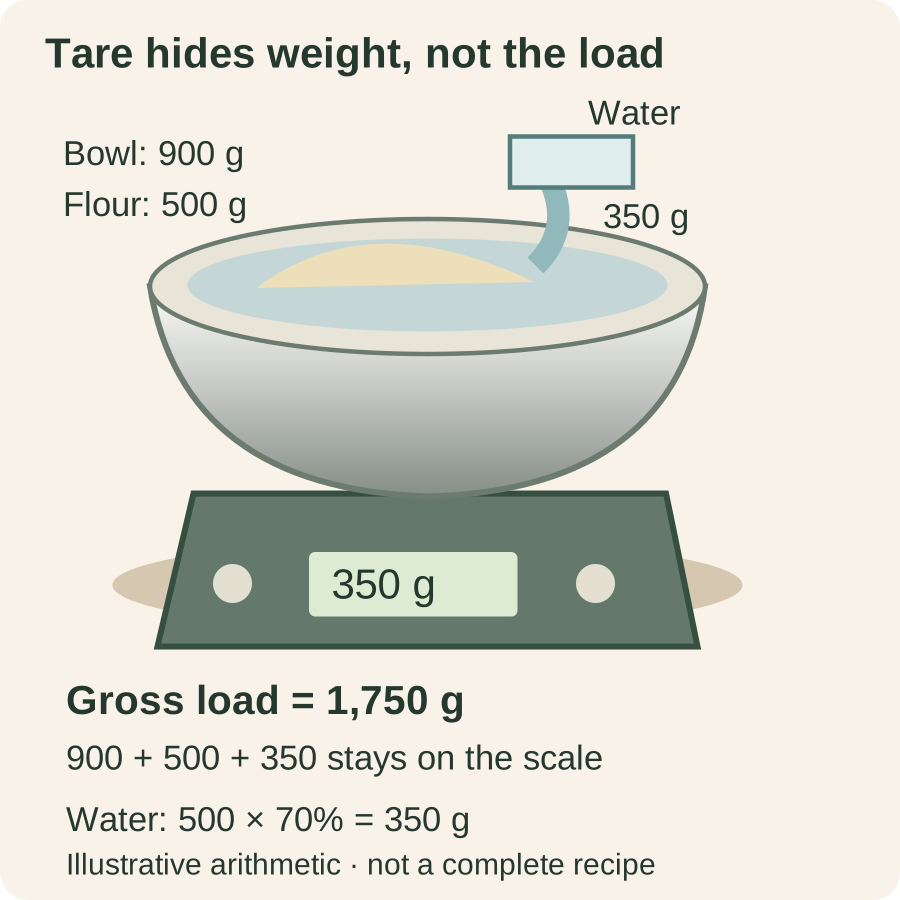
Tare makes the display show the added ingredient rather than the bowl’s weight. It does not make the bowl disappear physically, so do not plan a maximum-capacity batch as if its container adds nothing to the load.
Here is an original planning example: a 900 g bowl holding 500 g flour and 350 g water starts with a 1,750 g gross load. Add the weights of the rest of your recipe before deciding whether a scale’s stated capacity comfortably covers it.
If you zero between ingredients, write down your recipe targets and tick each one off as you go. A notebook is much less frustrating than trying to reconstruct how much water you poured after losing your place.
Understand percentages and small amounts separately
King Arthur Baking defines baker’s percentages with flour as the 100 percent reference. With 500 g flour, a 70 percent water target is 350 g because you multiply 500 by 0.70.
You can do that arithmetic on paper and use any suitable gram scale. A dedicated percentage mode is a convenience when you prefer that workflow, rather than a requirement for making a small loaf.
A recipe asking for 0.5 g of yeast presents a different problem from a recipe asking for 350 g of water. A one-gram display cannot show every half-gram step, so select suitable equipment or a recipe’s documented measuring method for that amount.
Keep your recipe visible while you compare
Before you order, copy one actual recipe onto a sheet and circle its smallest quantity and heaviest loaded container. This gives you two concrete requirements instead of a vague wish for a scale that does everything.
If you mostly bake one small loaf, the extra KD-8000 capacity may remain unused while its larger shape occupies your shelf. If you weigh flour into a wide bowl several times a week, the OXO display mechanism may solve an inconvenience you encounter every single bake.
Think about who else uses the kitchen, too. Someone who only wants to weigh a lunch portion may appreciate the Primo’s simple controls even if you enjoy experimenting with percentage formulas.
These recommendations come from the documented layouts and functions of three verified listings, not an exhaustive market test. We did not measure drift, speed, durability, or long-term battery performance, so use a seller’s current return terms as part of your purchase decision rather than treating this shortlist as a guarantee.
Do these checks when your scale arrives
Start on a stable, level surface and read the actual manual in the box. Keep the platform free of nearby objects touching its edge, and check that your bowl rests on the platform rather than against the display or backsplash.
Practice the tare sequence with an empty bowl before you start a real recipe. Learn what happens when you remove the bowl, turn the unit off, or return after its automatic shutoff.
Do not use this practice to announce laboratory accuracy or calibrate the scale with an improvised household object. If readings behave unexpectedly, follow the manufacturer’s troubleshooting instructions and contact the seller or maker while your return options remain available.
Choose the Primo for simplicity, the OXO for display access, or the KD-8000 for its capacity and percentage workflow. The useful purchase is the one that lets you see what you are adding and repeat the process comfortably in your own kitchen.
Sources & research notes
Documentation checked October 22, 2026. Recommendations reflect documented features and original analysis, not measured product testing.
- 11 lb capacity, pull-out display, zero/tare, 1 g metric increments; no independent accuracy claim
- Escali manufacturer-issued Primo manual: two buttons, 5000 g and 1 g increments, nonwaterproof, stable level surface
- KD8000 model, 8000g x 1g specs on p5, tare, percentage function and LCD cover interference caution
- KD8000 8000 g x 1 g documented specifications and percentage mode
- Flour is 100 percent reference for baker percentages
- Escali Primo P115CH exact variant/image verification; no retailer reviews copied
- OXO Good Grips 11-pound food scale exact variant/image verification; no retailer reviews copied
- My Weigh KD-8000 exact variant/image verification; no retailer reviews copied