Best Picks & Buying Guides · Research-based comparison
Best Airtight Containers for a Flour-and-Sugar Baking Station
This article contains Amazon affiliate links. Best Products House may earn a commission from qualifying purchases. Read our disclosure.
In this guide Jump to a section
- Capacity and closure are different choices
- Begin with the bags you actually buy
- OXO Big Square Medium POP: push-button storage
- Rubbermaid Brilliance 12-cup: a sugar-sized role
- Progressive Flour ProKeeper+ PKS-101: an included leveler
- Compare closures through your real measuring motion
- Preserve identity and dates after decanting
- Choose a station rather than a matching photograph
- Make a conditional final choice
For a flour-and-sugar baking station, compare OXO’s 4.4-quart Big Square Medium POP container, Rubbermaid Brilliance’s 12-cup Pantry Sugar container, and the Progressive Flour ProKeeper+ PKS-101. Choose containers by the ingredient, package size, opening, and available shelf space rather than buying matching shapes automatically.
This comparison uses documented capacities, closures, and included features, not independent airtightness or shelf-life testing. The three options serve different practical roles, so you may prefer a mixed station instead of asking one container size to fit every ingredient.
Capacity and closure are different choices
| Candidate | Documented capacity | Practical distinction |
|---|---|---|
| OXO Big Square Medium POP | 4.4 qt / 4.2 L | Square button-lid arrangement |
| Rubbermaid Brilliance 1994227 | 12 cups | Sugar-sized latch-lid role |
| Flour ProKeeper+ PKS-101 | Maker: 4.36 qt; listing: 4 qt | Five-pound flour-bag scope; included magnetic leveler |
Begin with the bags you actually buy
Write down the normal package size for your flour and sugar, how quickly you use each, and whether you want to keep the original bag inside a larger container. Those choices affect both the volume you need and the way you preserve package information.
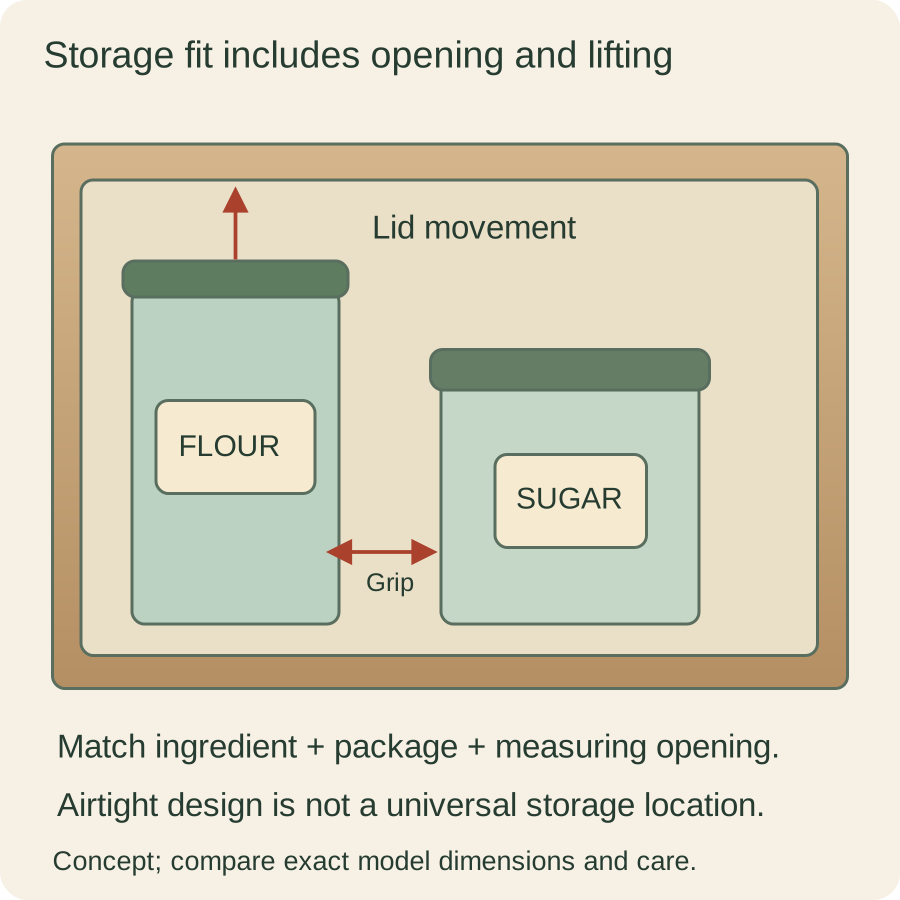
Measure the shelf’s usable height, depth, and clear opening. Include the lid movement and your hand’s access, not just whether a closed container slides between the shelf supports.
Choose a clear landing position near your scale or measuring cups. A container that fits in storage can still be awkward when you need to lift it out, open it, and add a controlled amount to a recipe.
Keep the ingredients’ own storage directions in the plan. An airtight container is one part of an appropriate arrangement, not a universal reason to keep every flour on the same warm countertop.
OXO Big Square Medium POP: push-button storage
OXO’s current Big Square Medium POP container is identified as 4.4 quarts or 4.2 liters in the product title and specification table. It uses a push-button lid arrangement and is listed as a stackable pantry-storage option.
The manufacturer’s page gives dimensions of approximately 6.25 by 6.3 by 9.9 inches for this version. Use the full published outline when you check your shelf, leaving the additional room needed for opening and comfortable handling.
Choose the OXO if the square footprint and lid mechanism suit your station. Check the current version carefully because the POP family includes many heights, shapes, and lid materials that should not share one assumed cleaning rule.
The maker’s descriptive paragraph contains a capacity wording inconsistency compared with its title and specifications. Rely on the clearly identified 4.4-quart variant and resolve any mismatch with the actual package before treating its capacity as settled.

The tradeoff is that a tall square container may need to come fully off a low shelf before you can measure comfortably. That can be perfectly workable if the lifting route and counter landing are part of your plan.
Rubbermaid Brilliance 12-cup: a sugar-sized role
Rubbermaid identifies its Brilliance Pantry Sugar container as model 1994227 with a 12-cup capacity. The documented design includes a clear body and lid, secure latches, and an airtight seal.
The manufacturer presents this as a sugar container and a modular pantry-storage piece. That makes it worth considering for the sugar side of the station instead of assuming it holds the same amount as a larger flour container.
Choose it if the latch closure and rectangular form suit your shelf and your usual sugar supply. Compare the actual volume with the ingredient amount you want to store; a cup capacity is not a universal weight capacity across different foods.
Rubbermaid lists top-rack dishwasher permission and freezer-safe use for this model, while specifying that it is not microwave-safe. Keep those permissions attached to the exact model rather than extending them to every Brilliance product or any container with similar latches.

The tradeoff is that this is not the largest-volume option here. Plan a labeled reserve position if your normal package does not fit with the measuring access and closure space you need.
Progressive Flour ProKeeper+ PKS-101: an included leveler
Progressive’s manufacturer-issued ProKeeper+ catalog identifies the Flour ProKeeper+ as PKS-101. It documents an airtight silicone seal, a removable magnetic leveler stored in the lid, and capacity for a standard five-pound flour bag.
The catalog lists its capacity as 4.36 quarts or 4.13 liters, which is distinct from the older PKS-100 Flour ProKeeper’s four-quart specification. Keep the Plus model and original model separate when comparing listings and replacement accessories.
The linked Plus Flour listing calls the container four quarts, which conflicts with the catalog’s 4.36-quart figure. Confirm the supplied package identifier and capacity before relying on the larger published number for a tight storage requirement.
Choose the PKS-101 if a flour-focused container with an included leveler suits the way you measure. The accessory is most relevant if you use a measuring cup through the recipe’s proper technique; it does not change a scale-based recipe into a volume recipe.
Check that the listing and supplied package include the leveler described for the selected version. A similarly named container without the same accessory is a different practical offer even when its main body looks familiar.


The tradeoff is a more specific flour-station arrangement with its own lid and accessory to maintain. If you usually pour directly onto a scale, decide whether the included leveler provides a benefit you will actually use.
Compare closures through your real measuring motion
Picture opening each candidate with clean, dry hands and placing its lid somewhere suitable. A button and a pair of latches create different movements, and your preference may depend on where the container sits.
Check whether the scoop or measuring cup you use can enter and turn through the opening. An attractive tall container can be inconvenient if you repeatedly catch the rim while trying to remove the last portion.
If you weigh ingredients, rehearse lifting and pouring from a similar cool, empty vessel without claiming it reproduces a candidate’s full weight. The point is to understand your counter route and reading visibility before the real container arrives.
Keep any manufacturer instructions about carrying and lid handling in the routine. A closure’s sealing function does not automatically make it a suitable handle for lifting a filled container.
Preserve identity and dates after decanting
Label the full ingredient name and type so similar white powders remain distinguishable. Keep the package’s best-by and lot information available, whether the original bag stays inside or you save a clear record separately.
Do not top up indefinitely until the oldest contents become impossible to identify. Use a deliberate refill method consistent with the ingredient and container guidance, and update the package information when the supply changes.
Clean and dry a container through its permitted method before refilling when the care instructions require it. The goal is a suitable dry-storage setup, not simply a container that looks clean from the outside.
For flour with different storage needs, follow the actual package and relevant food guidance. Container uniformity should never override a reason to keep one ingredient in another suitable location.
Choose a station rather than a matching photograph
You might choose one flour-focused container and a smaller sugar container instead of two identical boxes. Compare the paired arrangement with the shelf and recipe station, including the empty space you need to lift each one independently.
If you keep an original bag inside a container, check the bag’s actual dimensions as well as the nominal ingredient amount. A container that holds loose flour may not comfortably accept the same bag without folding or crowding the lid.
Leave measuring room above the food rather than filling every vessel to its absolute edge. Your buying target should include comfortable everyday access, not just a one-time demonstration that the contents can be squeezed inside.
Keep reserve stock labeled and visible enough to avoid unnecessary duplicate purchases. A larger set adds value only when the extra containers support ingredients you really buy and can clearly identify.
Make a conditional final choice
Start with the OXO 4.4-quart POP if you prefer its square push-button arrangement and the documented height works. Consider Rubbermaid Brilliance 12-cup for a sugar-sized role where a latch closure suits your routine.
Choose the Flour ProKeeper+ PKS-101 if its five-pound flour-bag scope and included leveler address your actual measuring method. Confirm the Plus identifier rather than borrowing the older model’s capacity or included parts.
Choose none if the opening, filled lifting route, or storage conditions do not suit the ingredient. Keeping a properly protected original bag in an appropriate location can be better than decanting into an inconvenient container.
Before ordering, match the exact model, capacity, package count, and lid version to the linked listing. The useful station makes ingredients identifiable and easy to measure while respecting their own storage requirements, with no need to promise that a container keeps every food fresh indefinitely.
Sources & research notes
Documentation checked October 23, 2026. Practical examples are original planning exercises; product recommendations compare documented features.