Cookware Skills · Practical guide
What Oven-Safe Really Means for Your Pan, Lid, and Handles
In this guide Jump to a section
- Identify the whole assembly
- Find the exact temperature and use condition
- Separate oven use from broiler use
- Watch for shortcuts in product descriptions
- Plan the stove-to-oven transfer
- Respect temperature changes as well as the maximum
- Inspect before reusing a questionable piece
- Keep a short use note where you will find it
- Work through a hypothetical limit
“Oven-safe” means you need to check the exact assembled cookware, the permitted temperature, and the type of oven use. A metal pan body does not automatically give its lid, knob, handle covering, or removable accessory the same limit.
Before you move dinner from stove to oven, identify the pieces you are actually using and find their instructions. The safest useful answer is tied to that model and configuration, rather than to the material’s general reputation.
Identify the whole assembly
Start with the pan’s model or product name, then inspect the lid, knob, and handles while everything is cool. Note any components that were replaced, added, or borrowed from another piece of cookware.
A lid that physically fits can still have different use limits from the pan beneath it. Treat it as a separate item until the maker’s documentation confirms the complete arrangement you intend to use.
Look for silicone sleeves, wooden grips, plastic parts, and other additions that may have their own instructions. Do not assume an accessory becomes oven-safe merely because it attaches to a pan that is.
If you bought the cookware used and cannot identify a component, leave its oven suitability unresolved. An uncertain knob is a reason to contact the manufacturer, not a reason to estimate its material from a photograph.

Find the exact temperature and use condition
Read the current care instructions for the specific product and material. Look for maximum temperature, whether the lid is included in that statement, and any limits on duration or particular cooking methods.
Le Creuset’s care guidance illustrates why components matter: its listed limits differ between phenolic components, stainless-steel knobs, glass lids, and other pieces. Those published distinctions are specific to the manufacturer’s products and should not be transferred to an unidentified pan.
Record the lowest applicable limit for the assembly you will actually put in the oven. If the pan permits a higher temperature than its lid, the pan’s higher number does not raise the lid’s rating.
Keep the source and model alongside the number in your notes. Writing “oven-safe” on a cupboard label without the configuration and limit can recreate the same uncertainty the next time you cook.
Separate oven use from broiler use
Search the instructions for the word “broiler” instead of assuming ordinary oven permission includes it. A direct overhead heat source is a separate use condition that the manufacturer may address differently.
Also check the rack placement and any required distance from the heat source. A pan fitting underneath the broiler tells you about physical space, not whether the maker allows that arrangement.
Do not treat a short broiling time as an exception to a prohibition. If you cannot find explicit permission for the exact cookware and assembled parts, choose equipment with clear instructions for the task.
The same care applies to countertop ovens and other compact cooking appliances. Check both sets of instructions, because the cookware’s suitability and the appliance’s rules must agree.
Watch for shortcuts in product descriptions
A product family can contain several materials and handle designs, even when the names sound nearly identical. Open the exact variant’s product information rather than relying on a broad brand comparison.
Distinguish a claim about the pan body from a statement about the complete set. A retailer may place a shared feature near several products while the manufacturer provides the component details elsewhere.
If the documentation and listing disagree, keep the discrepancy visible and contact the manufacturer. Do not choose the higher temperature simply because it suits your recipe.
A replacement knob marketed for one product line also needs a compatibility check. You should not improvise a hardware change and then assume the pan has acquired a new oven rating.
Plan the stove-to-oven transfer
Before cooking, check that the pan fits on the intended rack with its handles and lid in place. Do this while the oven and cookware are cool, using the actual assembled dimensions.
Choose a suitable heat-resistant landing place for the cookware after removal. Keep it available throughout the cooking process so you are not hunting for room while holding a hot pan.
Think about how you will grip every part needed for the move. Oven-heated handles can remain hot after the cookware returns to the counter, so do not let a familiar stovetop handle tempt you into an unprotected grab.
Keep other people informed when a hot pan has returned to the stove. An otherwise ordinary-looking skillet can be easy to mistake for one whose handle has not spent time in the oven.
Follow the maker’s heat-protection instructions and use dry, suitable protection for the job. A loose towel or an awkward grip should not become a substitute for a transfer you can perform securely.
Respect temperature changes as well as the maximum
A maximum temperature is not the only instruction that matters. Read any guidance about preheating, adding liquid, moving between temperature extremes, and allowing cookware to cool before cleaning.
Do not infer permission for a sudden temperature change from the fact that a material tolerates a hot oven. The maker may describe gradual heating or cooling requirements separately from its maximum rating.
For a recipe that calls for a preheated vessel, confirm that the exact cookware permits that method. A recipe’s technique and a product’s instructions have to work together; the recipe does not override the equipment limits.
If you need to adjust the recipe to use different cookware, do that before ingredients are in a hot pan. A planned change gives you more control than improvising around a missing permission halfway through dinner.
Inspect before reusing a questionable piece
Look for damage while the cookware is cool and clean, particularly on lids, handles, and attachments. If a component is loose, cracked, chipped, or otherwise questionable, check the maker’s instructions before continuing to use it.
Do not use an intact-looking pan body to dismiss damage elsewhere in the assembly. The part you grip or cover dinner with can be the part that determines whether the whole setup is usable.
Take clear photographs and send the model information to the manufacturer’s support team if you need help identifying a component. Describe how the part was used and what changed without trying to diagnose the material yourself.
Keep any unresolved piece out of the next cooking plan until you have a dependable answer. You can choose another documented piece of cookware while the question is being resolved.
Keep a short use note where you will find it
Create a simple note with the model, permitted configuration, maximum temperature, and broiler status. Add a link to the actual care page or manual so you can recheck it if you change a part.
Review the note whenever you replace a lid or accessory. Your cookware is a collection of specific components, and “oven-safe” becomes meaningful only when the instructions match the pieces you are about to heat.
Work through a hypothetical limit
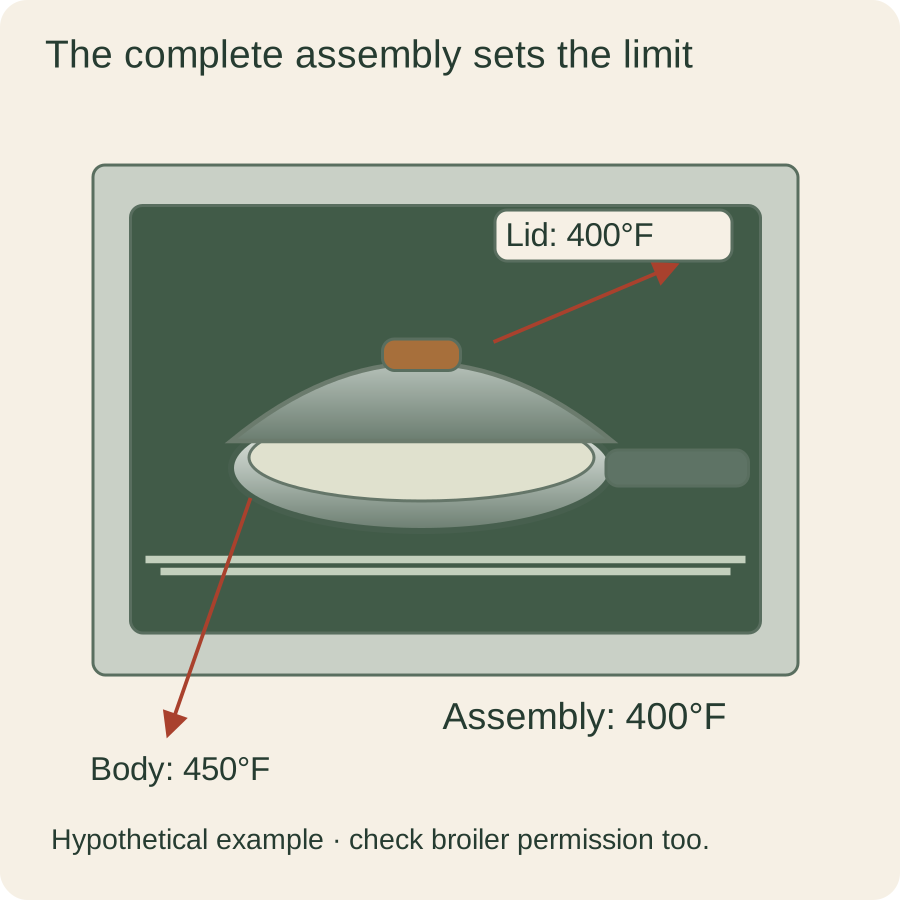
Imagine a documented pan body rated to 450°F and a matching lid rated to 400°F, while your recipe calls for 425°F. Those example numbers describe a decision exercise, not the rating of an unidentified product in your cupboard.
The complete covered assembly would be limited by the lid’s lower rating. You would need an explicitly permitted alternative arrangement or different cookware; the body’s higher number would not make the lid suitable for that recipe.
Now add a broiling finish to the hypothetical recipe. You still need to check separate broiler permission, because staying below an ordinary oven temperature limit does not answer that different use question.
This way of reading instructions keeps the important details together: component, temperature, configuration, and method. Once any one of those changes, recheck the answer instead of carrying a general oven-safe label forward.
Sources & research notes
Documentation checked October 22, 2026. Practical examples are original planning exercises; product recommendations compare documented features.