In this guide Jump to a section
- Choose one small working group
- Preserve the package information
- Match the container to the opening you need
- Keep storage conditions ingredient-specific
- Leave room for a clean transfer
- Plan a refill you can identify later
- Size the system to your shopping habit
- Rehearse one recipe at the shelf
- Keep a quick shelf note
Keep dry pantry ingredients easy to measure by giving each one a clear identity, an accessible opening, and an appropriate storage place. A tidy row of containers is useful only when you can tell what is inside and remove the amount your recipe needs.
Start with the ingredients you use regularly rather than replacing every package at once. You can improve one baking shelf with labels, a sensible refill routine, and room for the scoop or scale you actually use.
Choose one small working group
Pick a familiar recipe and gather its dry ingredients while they are still in their original packages. Notice which ones are awkward to open, easy to confuse, or difficult to return to the shelf after measuring.
Group ingredients by the work they support, while keeping their individual storage requirements. Flour, sugar, salt, and leavening may belong to the same recipe without belonging in identical storage conditions or equally large containers.
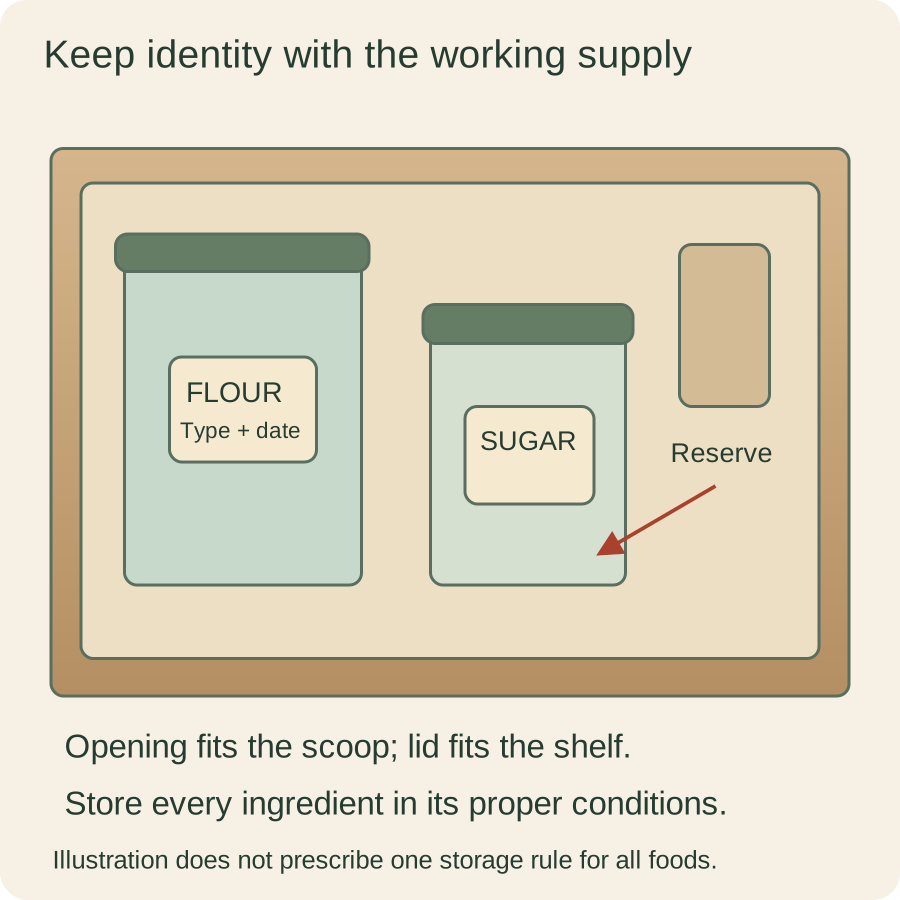
Separate your working supply from any reserve stock when that helps you handle it comfortably. You do not need to lift the largest package every time you want a modest amount for an ordinary bake.
Keep the group small enough to understand without an elaborate inventory system. A clear arrangement for the ingredients you use weekly can be more valuable than a fully decanted pantry whose labels you rarely update.

Preserve the package information
Before transferring an ingredient, record its full name, variety, and any relevant package instructions. Keep the best-by date and lot information accessible rather than discarding the only record of what you put in the container.
Distinguish similar-looking ingredients in plain words. All-purpose flour, bread flour, powdered sugar, and a different white powder should not depend on your memory of which shelf position they usually occupy.
Use a label you can read while the container is in its normal position. If you lift the container from a drawer, a top label may help; if you view it on a shelf, the front may be easier.
Do not make the label so permanent that it encourages topping up with an unidentified new ingredient. The container’s current contents should match the information you can actually verify.
Match the container to the opening you need
Check whether your preferred scoop or measuring cup fits through the opening with room to move. A tall narrow jar can look compact while making ordinary measuring unnecessarily awkward.
If you weigh ingredients, consider the pouring action as well as scoop access. A manageable container should let you add a controlled amount without supporting a heavy awkward box over the scale.
Measure the shelf with the lid’s required movement included. A container that fits when closed may still need to come out every time you want to open it, which can be fine if you have a comfortable landing place.
Check the container’s intended food-storage use and care instructions. Do not assume every decorative jar or reused household tub is suitable for direct contact with the ingredient you want to store.
Keep storage conditions ingredient-specific
King Arthur’s flour-storage guidance recommends an airtight container or bag and a cool, dark storage position. It also distinguishes whole-grain and nut flours when discussing longer-term storage, so avoid treating every flour as the same pantry item.
Follow the actual package and relevant manufacturer’s storage directions for the ingredient you own. A matching container set does not override a requirement that belongs to one particular food.
If you keep an ingredient in the refrigerator or freezer, label it and use a container permitted for that environment. Do not assume a pantry container is freezer-safe because it happens to have a tight lid.
Keep the storage location separate from the temporary measuring station in your thinking. An ingredient can live in its appropriate place and still come to the counter when you are ready to bake.
Leave room for a clean transfer
Give yourself a clear counter position to open the container and measure, with the recipe and scale or cups nearby. Move unrelated wet dishes and messy tools away from the working area before you start.
Use clean, dry measuring tools appropriate for the ingredient and recipe. Do not return a wet spoon or a scoop carrying another ingredient into the storage container merely to save a utensil.
Decide where the lid will rest while you measure. Setting it on an already dirty surface can create avoidable cleanup before you close the container again.
Close and return one container after you have finished with it when that suits the recipe’s order. This keeps the working area understandable and reduces the chance of adding the same white powder twice.
Plan a refill you can identify later
Check the remaining contents and package information before refilling. Avoid an endless top-up routine in which the age and identity of the oldest portion become impossible to track.
Follow the food and container guidance for emptying, cleaning, drying, and refilling. A washed container should be ready for dry storage before you add the next ingredient, rather than becoming a place where residual water is hidden.
Keep reserve packages labeled and arrange them so you can see what should be used next according to their information. A backup bag hidden behind several containers is easy to buy again unnecessarily.
When changing brands or flour types, update the container label and save the new package details. Similar texture and color are not reliable identifiers once the original bag has gone.
Size the system to your shopping habit
Write down the package sizes you normally buy and compare them with the container’s actual usable capacity. A nominal volume does not tell you that every ingredient’s standard bag will fit with comfortable measuring space above it.
Leave room for the lid’s internal parts and the movement of your scoop. Filling to the absolute brim can turn a convenient-looking container into something you spill whenever you open it.
If a full package will not fit, plan a clearly labeled reserve position rather than forcing the extra into another anonymous jar. You should know which two places hold the same ingredient and which package details belong to it.
Do not automatically buy a larger container for an ingredient you use slowly. The storage plan should reflect both your package size and the pace at which you actually use the contents.
Rehearse one recipe at the shelf
Walk through gathering, opening, measuring, closing, and returning the ingredients for your chosen recipe. Notice whether one container blocks another or whether you need to clear a space every time you set down a lid.
Ask another household member to identify the ingredients from the labels without your help. Their hesitation can reveal information you assumed was obvious because you designed the shelf.
Fix one repeated inconvenience at a time, such as an unreadable top label or a scoop that catches the opening. You can learn more from a week of ordinary use than from arranging every container for a photograph.
The useful pantry is easy to understand when you are ready to cook. Clear identity, appropriate storage, and comfortable measuring access give you that result with far less guesswork than a row of matching unlabeled jars.
Keep a quick shelf note
List the ingredients you want to restock and the containers that need attention while you can still see the shelf. A specific note prevents a shopping trip from becoming a guess about whether the hidden reserve bag is still there.
When the recipe changes or you begin using a different flour regularly, reconsider the working group. Let the pantry follow the food you actually prepare instead of preserving an arrangement that looked useful several months ago.
Sources & research notes
Documentation checked October 22, 2026. Practical examples are original planning exercises; product recommendations compare documented features.