Disclosure: As an Amazon Associate I earn from qualifying purchases.
A baking dish should fit the recipe, the oven, and the way you handle a finished meal. Material matters, but so do usable interior dimensions, depth, total filled weight, and where the dish will live between meals. A coordinated set can be useful when its sizes match your cooking; a single well-chosen casserole may be a better purchase when you repeatedly make one family recipe.
The original options below span clear glass, white porcelain, a deep rectangular ceramic dish, and covered stoneware. These are specification-based shopping candidates, not bake-test results. We have not measured their browning, temperature distribution, breakage resistance, or lifetime. Treat oven compatibility as a component-specific instruction rather than a promise that a dish, lid, and cold contents can move through any temperature change without consequences.
Start with the meals already in your kitchen
Choose three recipes you make regularly and write down the pan size each recipe expects. Note whether the stated measurement describes the interior cooking area or the whole dish. A “9 by 13” designation may refer to the usable area while a product’s overall length includes handles. That distinction can affect both how the recipe fits and whether the dish fits your oven rack or cabinet.
Then consider whether you normally cook the full recipe. If you often halve a casserole, a large set’s smallest dish may be more useful than its largest. If you cook for guests only a few times a year, buying several oversized dishes may create a storage problem for a rare event. Start with normal meals, then decide what occasional flexibility is worth paying for.
- Layered pasta: compare usable length, width, and depth against your usual recipe.
- Small side dishes: look for a size that holds the intended amount without needing a full family casserole.
- Desserts: follow the recipe’s pan-shape and depth assumptions rather than choosing solely by liquid capacity.
- Covered serving: confirm which lid belongs to which vessel and whether it is intended for cooking or storage.
- Make-ahead meals: plan the cooling, storage, and reheating method around the exact use-and-care instructions.
You do not need every size in a set to be equally useful, but identify the role of each before checkout. A bundle’s low price per piece is less persuasive when several pieces would remain unused or crowd the cabinet.
The five original bakeware options
M MCIRCO glass set: four dishes plus storage lids
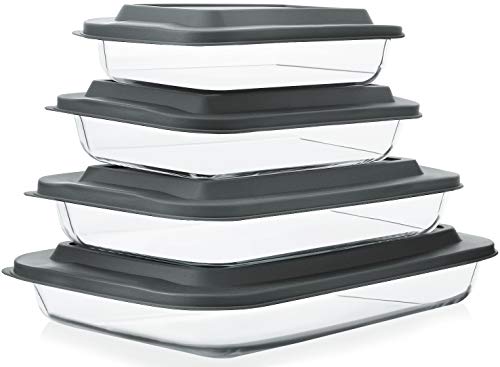
The original link identifies the M MCIRCO eight-piece deep glass set with gray lids. The eight-piece count includes dishes and covers, rather than eight baking vessels. Its clear sides are useful if you prefer to see the contents during preparation or serving, and the different sizes can support separate main dishes and sides. Check the actual measurements of each size instead of treating the whole set as one capacity.
The listing describes borosilicate glass, but that is not a guarantee against thermal-shock breakage. We do not endorse the earlier claim that refrigerator-to-oven transitions carry no cracking risk. Obtain and follow the supplied dish instructions, and keep plastic covers out of the oven unless the specific component is expressly rated for it. A fitted lid also does not prove leakproof transportation.
- Consider it for: households that will regularly use several rectangular sizes and want matching storage covers.
- Before buying: check each vessel’s dimensions, permitted heating appliances, lid care, and cabinet footprint.
- Tradeoff: more pieces need storage and inspection; lids and glass have different use limits.
View this selected option on Amazon
Pyrex covered glass pair: compare the two useful sizes

The current original listing identifies a Pyrex two-dish glass set with lids and handles, but its Extra Large title, an uninformative Select Size selection, and feature text naming 2- and 3-quart Easy Grab dishes do not establish a consistent package specification. Keep it as a conditional glass-set candidate until the seller confirms the exact dish models, capacities, and covers. Handles add to the exterior dimensions, so check the complete footprint before ordering for a small oven or narrow refrigerator shelf.
The brand’s glassware use-and-care instructions require a preheated oven and precautions against sudden temperature changes. Plastic lids are not for conventional or convection oven use. The brand name and the word freezer do not establish an unrestricted freezer-to-hot-oven method. Read the instructions packaged with the actual set before planning a make-ahead routine.
- Consider it for: buyers who need a medium and larger glass vessel with corresponding covers.
- Before buying: verify the delivered capacities, actual interior dimensions, handle clearance, and lid instructions.
- Tradeoff: even a confirmed two-size package may leave a gap for individual portions or an especially deep recipe.
View this selected option on Amazon
MALACASA white porcelain set: sizes for serving as well as baking
The original option is a four-piece white MALACASA porcelain baking set with rectangular vessels and integral handles. MALACASA’s corresponding bakeware information lists four nominal lengths from 9.4 to 14.7 inches. The selected listing explicitly says these measurements include handles, so they are not usable interior lengths. Check the interior dimensions if matching a recipe is important.
This set suits someone who wants several serving sizes in a consistent white finish and does not require supplied storage lids. Porcelain and a smooth glaze are material and appearance descriptions; they do not prove that the set is unbreakable, scratch-proof, or universally more durable than glass. Check the exact temperature limit and thermal-transition instructions supplied with the set rather than relying on an unspecific oven-safe statement.
- Consider it for: a household that will use several white rectangular serving and baking sizes.
- Before buying: compare each footprint, depth, filled weight, and permitted appliance use.
- Tradeoff: four lidless dishes may require separate approved covering or storage arrangements.
View this selected option on Amazon
DOWAN deep rectangular dish: prioritize capacity and handling
The original DOWAN link describes a soft-white 4.2-quart rectangular casserole, marketed around a 9-by-13 cooking format. The deep shape makes it a candidate for recipes needing more vertical room, but it is not automatically a substitute for every shallow pan. Check the actual interior and overall dimensions and leave the recipe’s required headroom rather than treating the nominal capacity as a recommended fill level.
DOWAN’s baking-dish page currently gives 500°F in its description and 482°F in its general usage guidance. We do not resolve that inconsistency by promising the higher limit. Obtain the instructions for the exact delivered dish and your intended temperature. The handles also do not make a large, filled ceramic casserole lightweight or safe for every user’s grip.
- Consider it for: someone who needs one deep family-size rectangular vessel.
- Before buying: confirm the exact heat limit, usable depth, total size, and comfortable handling.
- Tradeoff: depth and capacity add weight and may change how a recipe needs to be monitored.
View this selected option on Amazon
CorningWare French White set: count dishes and covers separately

The original link identifies a six-piece French White stoneware set with covered oval dishes. The listed sizes include 15 ounces, 1.5 quarts, and 2.5 quarts; verify the corresponding glass and plastic covers in the selected package. Six pieces does not mean six separate casseroles. The smaller covered vessel may be useful for an individual side or leftovers, while the larger ones provide a coordinated serving arrangement.
Choose this set if those oval sizes fit your meals and shelves. Do not transfer stove or direct-flame permissions from a different vintage CorningWare material onto current stoneware. Likewise, a photographed glass lid should not be treated as interchangeable with a plastic storage cover. Confirm the instructions for each component and avoid unsupported promises of even cooking, stain immunity, or guaranteed crack resistance.
- Consider it for: households that want several covered oval sizes for different portions.
- Before buying: check vessel count, lid allocation, component-specific heat permissions, and dimensions.
- Tradeoff: oval shapes may be less convenient for recipes written around a rectangular footprint.
View this selected option on Amazon
Capacity, depth, and footprint answer different questions
Liquid capacity describes how much a vessel can hold under the stated measurement method. It does not establish the quantity you should load into it for a bubbling casserole. Check a recipe’s required dimensions and leave its intended room for expansion or movement. A deeper dish with the same nominal footprint may suit one recipe while creating an unnecessarily thick layer for another.
Measure the space you actually have, with the oven cold. Record usable rack width and depth, including obstacles and the manufacturer’s required clearances. If you expect to bake two dishes together, plan their complete footprints rather than assuming the sum of their advertised widths is enough. Consult the oven manual about positioning and airflow; this guide does not prescribe universal spacing for every appliance.
Do the same for the refrigerator, cabinet, and dishwasher if those uses matter. Handles and covers can be the parts that prevent a good fit. A dish that fits an oven but cannot sit level on your chosen storage shelf may complicate the meals you intended to prepare ahead. Keep the shopping measurements together so one attractive product photograph does not outweigh a practical mismatch.
A useful size worksheet
Write a line for each candidate: interior length and width, usable depth, overall footprint, empty weight if available, and the meal it will hold. Mark an unknown measurement as unknown. Do not convert an overall handle-to-handle length into a recipe dimension. If an answer is critical, obtain a labeled drawing or a measurement from the manufacturer or seller before purchase.
Add a line for the largest location constraint. For example, your limiting dimension might be a narrow cabinet, not the oven. This keeps a multipiece set from winning the comparison simply because its largest dish looks generous. A smaller set can be the more useful option when every piece has a clear role and a convenient home.
Material is a choice of properties, not a quality ranking
Clear glass offers a view through the sides, which some cooks prefer when assembling layered food. Opaque porcelain or stoneware provides a different serving appearance. Neither observation proves more even cooking or better flavor. Materials, thickness, shape, finish, recipe, and the appliance all contribute to what happens in use, and we have not tested these options against one another.
Avoid treating porcelain, ceramic, and stoneware as three completely separate performance grades. Marketing names alone do not establish a product’s exact composition or strength. Similarly, the word borosilicate is not permission to ignore its maker’s instructions. Choose a documented vessel suitable for your intended heating method and a shape you will actually use.
A coating or glaze claim also needs an appropriate boundary. “Lead-free” in a listing does not provide this guide with an independent laboratory report for every shipped item. We do not use such language as a universal safety certification. Buy from a source that can identify the product and provide applicable use-and-care information, and retain that documentation for the dish you receive.
Lids deserve their own comparison
Decide whether you need a cover during cooking, after cooking, or both. A glass cooking cover and a plastic storage lid may have very different permissions. The fact that they fit the same vessel does not transfer the dish’s heat limit to the lid. Identify the material, intended appliance, and any venting requirement for each component before putting it into a heating routine.
For the Pyrex pair, use the brand’s instructions rather than assumptions based on another glass-storage range. For other sets, check their own supplied guidance. A lid labeled BPA-free is not automatically oven-rated or suitable for every microwave use. Keep unsupported leakproof and freshness-duration claims out of the decision; evaluate the actual closure and documented use instead.
Replacement availability can matter more than an extra cover in the bundle. Ask whether the maker sells the correct lid for that model and size. A nearly matching cover from another range is not necessarily a proper replacement. Include the likely storage arrangement for a lidless set when comparing costs, without purchasing accessories that the dish’s instructions do not permit.
Handle a realistic load before choosing a large dish
Consider the empty vessel plus food and any lid. Large ceramic dishes can be awkward even when their handle shape looks generous. With a cold display item, see whether the handle area gives enough room for the oven mitts you normally use. Do not interpret a ribbed handle as guaranteed slip prevention or an integral handle as proof that anyone can carry the full dish comfortably.
Plan the path from oven to an appropriate landing place. If that path is narrow or obstructed, a larger dish may be inconvenient regardless of its capacity. Your own kitchen arrangement matters more than a claim that a handle is ergonomic. Someone who cannot comfortably manage the intended load may prefer smaller separately cooked portions or help with transfer, while still following the recipe and manufacturer’s instructions.
For Pyrex, the use-and-care guidance specifically cautions against adding liquid to hot ware or placing hot glassware on wet or cool surfaces, and against using damaged pieces. These are use limits, not evidence that any other material is immune. Keep the relevant instructions accessible and plan a suitable dry landing surface before the meal is ready.
Build cleanup and storage into the purchase
A dishwasher-safe statement may help, but check whether it applies to the dish, each lid, or both. Look at your dishwasher rack and the amount of space the largest piece will occupy. If one casserole forces you to run a separate load, hand-cleaning requirements may become the more important part of your decision.
Check how easy it will be to reach corners, handles, and any textured area with the permitted cleaning tools. Follow the maker’s guidance about cooling, soaking, and abrasive products. Avoid making stain-proof or scratch-proof claims based on a smooth-looking glaze. A product you can clean and inspect conveniently is more useful than one bought on a promise that it will never show wear.
For storage, decide whether nesting is actually supported and whether the handles interfere. Photograph a proposed shelf arrangement or measure it before ordering a large set. Keep lids identifiable so the wrong cover does not become part of a later reheating routine. A coordinated appearance can be appealing, but a practical storage plan determines whether the set remains easy to use.
Select the purchase that fits your household
For a small household, start with the vessel that matches the meal you cook most often. A medium glass pair can cover two common portion sizes without requiring storage for a broad assortment. A deep single dish can suit a family casserole, provided you can handle it and the recipe needs its depth. A white porcelain assortment makes sense when several sizes genuinely serve different meals.
For entertaining, think about the whole menu rather than only the main dish. A covered oval for a side may be useful alongside a rectangular pasta bake. Check whether both fit your serving space and heating plan. Do not assume that a matching finish is a reason to replace bakeware you already own and use successfully.
On delivery, confirm the selected package and inspect each vessel and cover before cooking. Resolve missing parts, visible damage, or inconsistent instructions with the seller or manufacturer. Keep the packaging until any discrepancy is settled. The best outcome is a documented dish you can fit, handle, store, and use as intended, with a clear purpose in your normal cooking.