Disclosure: As an Amazon Associate I earn from qualifying purchases.
The best pan for pasta sauce depends on what you mean by making sauce. Warming a small amount of prepared sauce, simmering a family batch, and tossing cooked pasta with sauce are different jobs. A small saucepan can be convenient for the first task while offering too little working room for the last. Begin with your normal meal and the pan shape specified by your recipe, then compare capacity, handle arrangement, lid, and cooktop compatibility.
The original linked options below are saucepans in roughly one- to three-quart sizes. They are shopping candidates based on current selected listings and applicable manufacturer information. We have not tested their heating speed, simmer control, energy consumption, or resistance to sticking. Layer counts and nonstick names describe construction or marketing; they do not prove that a sauce cannot scorch or that every cooktop will heat a particular pan satisfactorily.
Decide which part of the meal this pan will handle
Write down whether the pan will make the sauce from ingredients, warm sauce you already prepared, or hold sauce while pasta cooks separately. Include the quantity you normally serve and whether guests are a frequent occurrence. A pot selected for one modest portion need not accommodate an occasional large gathering, but it should have enough room for the intended contents and the recipe’s stirring requirements.
Next, decide where the pasta will meet the sauce. If your recipe calls for finishing it in a wide pan, the small saucepans here may still make or hold the sauce, but should not be presented as equivalent finishing pans. The word pasta in a listing does not establish room for long noodles, water, sauce, and stirring in the selected capacity. Keep the roles separate rather than forcing one small vessel to perform every step.
A useful shopping description might be “a small pan for heating enough sauce for my usual two-person meal,” or “a larger saucepan for a batch I stir regularly and serve with pasta cooked elsewhere.” That tells you more than searching for the highest ply count. It also helps identify whether your current pan already handles the task and whether the proposed purchase fills a real gap.
Starting scenarios
- One serving or a small topping: compare the one-quart and smaller saucepan candidates against the actual recipe amount.
- A modest meal prepared regularly: check the available working volume in a 1.5- or 2.5-quart option without assuming nominal capacity is a recommended fill level.
- A larger batch or visitors: consider whether the three-quart candidate has enough room, or whether none of these original options meets your requirement.
- Pasta tossed in sauce: follow the recipe’s required shape and working space; do not choose a small saucepan merely because it has a strainer lid.
The five original saucepan configurations
Farberware Glide three-quart: a nonstick option with a clear induction limit

The original linked Farberware Glide is a black three-quart aluminum saucepan with a straining glass lid. Farberware’s corresponding product information identifies CopperSlide ceramic nonstick, an oven limit of 350°F, and no induction suitability. Those are important purchase boundaries; do not select it for induction simply because a different Farberware range supports that cooktop.
This is a candidate for a buyer who wants a coated cooking surface and a larger capacity among this shortlist. The coating name does not establish that sauce needs no attention, releases under every condition, or can be cleaned with any utensil. Follow the exact care instructions and check the lid and handle permissions before oven use. We do not make a lifetime-performance or universally chemical-free claim.
- Consider it for: a compatible non-induction kitchen and a buyer who prefers a coated saucepan.
- Check first: three-quart capacity, actual base footprint, care requirements, and component-specific heat limits.
- Tradeoff: its cooktop restriction can outweigh its other features for an induction household.
View this selected option on Amazon
DCIGNA 2.5-quart: compare usable size and documentation

The selected original DCIGNA option is a silver 2.5-quart stainless-steel saucepan with glass lid. The listing describes measurement markings and a pouring/straining arrangement. Those features can be useful to someone who wants more capacity than the smallest saucepans here, provided the pot fits the burner and the full container is comfortable to handle.
The marketplace’s five-ply and induction wording should not become a guarantee of uniform heat or universal cooktop fit. The visible dimensions are not consistently presented, so obtain the actual base diameter, overall footprint, and applicable instructions when space or induction detection matters. A matte interior is not proof against scratching. Similarly, a strainer lid does not certify that every pouring task can be completed without spills or separate equipment.
- Consider it for: a buyer wanting this intermediate nominal capacity and a stainless cooking surface.
- Check first: confirmed dimensions, exact construction, cooktop suitability, lid fit, and supplied care instructions.
- Tradeoff: incomplete or inconsistent measurements make an online comparison less certain.
View this selected option on Amazon
AVACRAFT 1.5-quart: keep the capsule-bottom model distinct
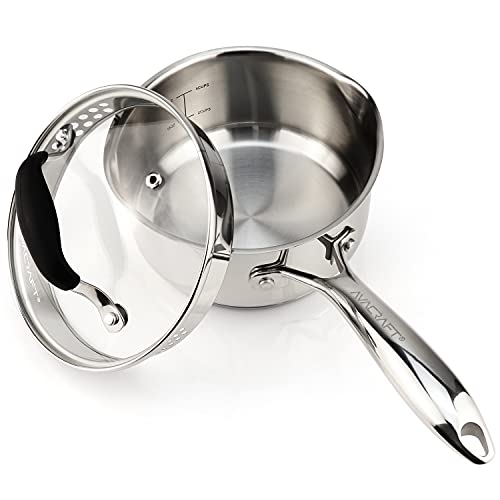
The original current title and selection identify an AVACRAFT 1.5-quart stainless-steel saucepan. Its overview describes a five-ply capsule bottom, while the feature text discusses a 3.5-quart full-body tri-ply sauté pan. That feature paragraph is not reliable evidence for the selected saucepan’s construction, oven temperature, or handle permissions.
AVACRAFT’s Signature saucepan information describes its capsule-bottom family and includes a 1.5-quart size. Keep this as a conditional candidate for a smaller saucepan, and verify the actual model and instructions supplied. Do not transfer the misplaced feature’s full-clad construction or numerical heat limits onto this original item. The exact variant matters more than the shared brand name.
- Consider it for: a smaller sauce quantity after the actual capsule-bottom model is confirmed.
- Check first: 1.5-quart selection, delivered model label, base construction, strainer lid, and component-specific permissions.
- Tradeoff: the listing’s misplaced family description needs resolving before a confident specification comparison.
View this selected option on Amazon
P&P CHEF one-quart: a small portion specialist

The selected original package is one P&P CHEF one-quart saucepan with lid, not a larger pot or a multipack. Its listing identifies a stainless-steel pot with a layered base and a tempered-glass cover. This size is worth considering for a small quantity of sauce or a separate topping when the actual recipe amount leaves comfortable working room.
Its limited capacity should be treated as a deliberate choice. A one-quart label does not establish that you can boil a full meal’s pasta and prepare its sauce in the same pot. Do not convert the seller’s rapid-heating, heat-dissipating handle, or healthy-material wording into proven energy savings or burn prevention. Obtain the exact instructions before relying on a cooktop or oven-use claim, especially because lids and vessels can have different permissions.
- Consider it for: a small sauce quantity or a secondary pan alongside a larger cooking vessel.
- Check first: one-pan package, useful depth and diameter, required headroom, and actual component instructions.
- Tradeoff: the smaller footprint comes with limited working volume.
View this selected option on Amazon
SLOTTET 1.5-quart with steamer: buy the selected package you will use

The current original link selects 1.5 Quarts, Saucepan with Steamer. Its listing describes stainless construction, pouring spouts, a straining glass lid, and the included steamer arrangement. This is a relevant saucepan candidate if you want that small capacity and will actually use or store the extra component. Do not compare its price with a bare pan while ignoring the selected package.
The claimed full-body tri-ply construction is a listing specification, not our verified heating result. We also do not endorse the claimed handle remaining cool over a gas stove or guaranteed energy savings. Obtain the actual component instructions before applying any oven limit to the pan, lid, handle, or insert. A straining lid does not replace the need to assess controlled handling of a filled hot pot.
- Consider it for: a shopper needing a small saucepan who has a practical use for the selected steamer package.
- Check first: 1.5-quart selection, included insert, storage height, base size, and each component’s care permissions.
- Tradeoff: the accessory adds storage needs without increasing the saucepan’s sauce capacity.
View this selected option on Amazon
Size the pan around the recipe rather than the label
Read the recipe’s expected sauce quantity, ingredient additions, and vessel guidance. A pan that holds the starting liquid may still be inconvenient once chunky ingredients are added or the mixture needs stirring. Nominal capacity is not an instruction to fill to the rim. Choose enough working room for the actual task without inventing a universal fill percentage that applies to every recipe.
Use your usual portion as the baseline. If you often make a double batch, decide whether the purchase is intended to accommodate that batch or whether you will keep using another vessel. A larger pan can be useful, but it must also fit the cooking area and your preferred storage. Buying the maximum size “just in case” can make a simple everyday task unnecessarily awkward.
Compare the base diameter, side height, total length with the handle, and any lid or insert height. Ask whether published measurements describe the vessel, the package, or the complete set. Do not treat a box dimension as the cooking footprint. For the DCIGNA option, where the listing presents dimensions inconsistently, this clarification is particularly useful.
Make a practical capacity note
Record the recipe, usual amount, intended pan role, and whether another vessel will handle the pasta. Add any extra need such as storing an insert or serving directly from the pot. Then write the selected capacity beside those requirements. This keeps the comparison tied to a meal you actually cook rather than to an abstract claim that a certain size suits everyone.
If the available candidates are all too small for your routine, acknowledge that mismatch instead of stretching their suitability. A well-defined requirement is still useful when none of the original linked options matches it.
Construction terminology needs a location
“Ply” is incomplete information unless you know where the layers are. A capsule or encapsulated base is a construction description at the bottom; full-body cladding describes a different arrangement. AVACRAFT’s construction explanation distinguishes those categories. Do not treat a five-layer base as proof that the sidewalls have five layers, or transfer a full-body feature from another product onto a selected capsule-bottom pan.
A layer count also does not establish a ranking of the saucepans here. Thickness, shape, the cooking surface, the appliance, and the way you use the pan all matter. We have no comparable measurements that would let us promise one candidate has fewer hot spots or simmers more steadily than another. Ask for a clear construction diagram when that distinction affects your purchase.
For the coated Farberware, identify the cooking surface separately from the aluminum body. A copper-colored ceramic-nonstick description is not the same as a solid copper saucepan. For the stainless options, a steel grade in the listing should not become a blanket food-safety certification, corrosion-proof promise, or claim that every ingredient can be stored in the pan indefinitely.
Check the cooktop before paying for features
Use the instructions for your actual cooking appliance when comparing pan size and suitability. If you use induction, confirm that the exact saucepan supports it and that its base meets the appliance’s requirements. A magnetic-material statement or a generic “all cooktops” bullet is not enough to settle every model’s minimum-size or detection question. Farberware explicitly excludes induction for the Glide option linked here.
On other cooktops, check the intended pan position and how the handle will sit alongside neighboring cookware. A long handle may crowd another burner or a narrow counter. A relatively tall small pan may also be less convenient for stirring than its capacity suggests. Assess the arrangement with the stove cool, and follow the appliance’s guidance rather than applying a universal burner-setting number.
Do not buy an adapter or make an appliance alteration merely to force a mismatched pan into service. A compatible candidate with suitable dimensions is the useful target. If the necessary compatibility or base measurement is unknown, resolve it before ordering instead of treating the return policy as your only plan.
Match the surface to the way you cook and clean
A coated surface can appeal to someone who prefers it for sauces, but it still needs the right utensils and care. Read the model’s guidance about heat, cleaning, and wear. Do not assume that dishwasher-safe means every cleaning product or metal tool is allowed, or that a coating removes the need to stir and monitor the recipe.
Stainless cookware offers a different surface and cleaning routine. It is not automatically nonstick, and a polished finish does not guarantee effortless release. Choose according to the care you will actually perform. If your main priority is quick cleanup after a small sauce portion, compare access to the bottom and corners as well as the nominal surface type.
Sauce ingredients should also be part of the use check. If you regularly cook tomato-based sauce, confirm the maker’s instructions for the actual cooking surface and for storing food afterward. Cooking suitability and long-term food storage are separate permissions. Avoid letting a generic stainless or chemical-free label answer both questions without documentation.
Lid, pouring, and handle features have limits
A transparent lid lets you see some of what is happening, but steam and condensation can affect that view. A vent or strainer opening is a design feature, not proof that the lid cannot break or that pressure and steam can be ignored. Check how it seats and how the handle is intended to be used according to the exact instructions.
For thick sauce, a strainer may not be the feature you use most often. A pouring spout can be convenient, but assess the whole movement with the pot’s intended load in mind. If a pouring method feels awkward, serving with a suitable utensil may be more practical. Do not imply that integrated holes remove the need for controlled handling or make every draining task easier for every user.
Compare the handle when the display pot is cold, including the space available for the hand protection the instructions require. A seller’s stay-cool or ergonomic phrase does not guarantee a comfortable filled weight or prevent heat transfer in every situation. Decide whether you can manage the whole vessel and whether assistance or a different serving method would be preferable.
A useful purchase worksheet
For each candidate, record its selected capacity, confirmed base diameter, complete length, construction location, cooktop permission, and included lid or insert. Mark conflicts as unresolved instead of copying the most attractive specification. Add the required care and any missing documentation to the same note. This makes comparing prices more meaningful because the configurations are clearly defined.
Then assign the pan one primary job. The one-quart P&P CHEF might be considered for a small topping; a 1.5-quart candidate for a modest sauce quantity; the DCIGNA for an intermediate requirement; and the three-quart Farberware for a larger amount on a compatible non-induction cooktop. These are capacity-based starting points, not promises of a particular number of servings.
Include the selected package in the price comparison. A steamer you do not need can add storage without improving sauce preparation. A lid that requires more careful cleaning may matter to your routine. Check replacement-lid availability and return conditions before using the pan, especially when a listing contains unresolved model or construction information.
Inspect the delivered pan and keep the decision specific
Compare the model label, selected size, included components, and supplied instructions with your order. Inspect for visible shipping damage or a loose component before cooking, and resolve any discrepancy with the seller or manufacturer. Do not attempt a repair or assume a misdescribed lid has the same permissions as the vessel.
Keep the manual available for its component-specific heat and care limits. Avoid assigning a fixed simmer setting, cooking time, or energy-saving percentage to any candidate. Follow the recipe and the applicable equipment instructions while becoming familiar with the actual pan. A purchase is successful when it fits the intended meal, appliance, handling, and cleanup routine.