Traveling often means relying on taps, airports, and gas stations for hydration. A reliable water purifier bottle can provide safe, great-tasting water wherever you are. This guide reviews top-performing bottles that remove contaminants, improve flavor, and fit easily into backpacks, purses, or carry-on luggage. Each option below is evaluated for portability, filtration efficiency, and practicality for travelers in the United States.
Summary of Selected Products
| Product | Brand | Capacity | Key Benefit |
|---|---|---|---|
| LifeStraw Go Series 22oz | LifeStraw | 22 oz | Removes bacteria, parasites, microplastics; taste improvement |
| Brita Hard-Sided 26 oz | BRITA | 26 oz | Reduces chlorine taste/odor; convenient for daily travel |
| LifeStraw Go Series 22oz Terrace Green | LifeStraw | 22 oz | Same high filtration with a different color/design |
| LifeStraw Go Series 1L Aegean Sea | LifeStraw | 1 L | Extended capacity for longer excursions |
| GRAYL UltraPress 16.9 oz | GRAYL | 16.9 oz | All-pathogen purification; quick, simple operation |
LifeStraw Go Series 22oz Water Filter Bottle

The LifeStraw Go Series 22oz is designed as a flexible travel companion. The BPA-free bottle pairs with a carbon filter to reduce chlorine taste and odors, creating a better-tasting water from many public sources. Its membrane microfilter protects against 99.999999% of bacteria (including E. coli and Salmonella), 99.999% of parasites (including Giardia and Cryptosporidium), and 99.999% of microplastics, along with sand, dirt, and cloudiness. This makes it suitable for airports, hotel rooms, and roadside stops where water quality can vary.
Brita Hard-Sided 26 oz Water Bottle

The Brita 26 oz filter bottle is BPA-free and focuses on taste and odor reduction. Its activated carbon block filter helps reduce chlorine taste and odors, with additional reduction of particulates in drinking water. Note that this bottle is not a true purifier; it improves taste and reduces certain impurities. It’s a practical option for travelers who want a cost-effective way to enjoy better-tasting water from most municipal sources and avoid single-use plastics by replacing up to 300 standard 16.9-oz bottles with a single filter.
LifeStraw Go Series 22oz Terrace Green
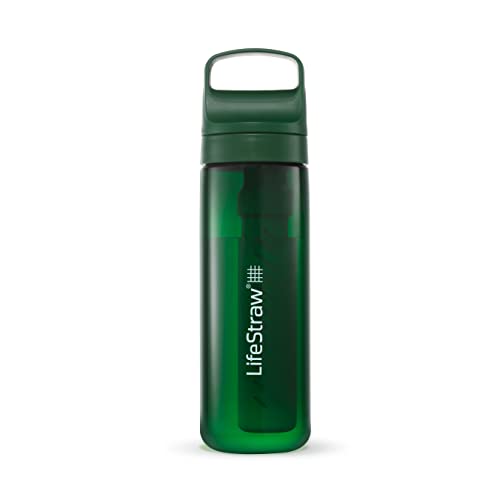
This LifeStraw variant emphasizes the same core filtration technology with a distinct terrace-green color. It’s ideal for travelers who want visual differentiation among gear. The bottle’s carbon filter improves taste by reducing chlorine and various odors. Filtration remains robust: bacteria, parasites, and microplastics are substantially mitigated by the membrane microfilter, ensuring safer drinking water while on the move.
LifeStraw Go Series 1L Aegean Sea

With a larger capacity, the 1-liter LifeStraw Go is well-suited for longer day trips or shared use. It retains LifeStraw’s dual-stage filtration—carbon for taste and a membrane microfilter for defenders against bacteria, parasites, and microplastics. The Aegean Sea colorway helps you identify your bottle in group settings, while maintaining the same compact profile for travel and daily errands.
GRAYL UltraPress 16.9 oz
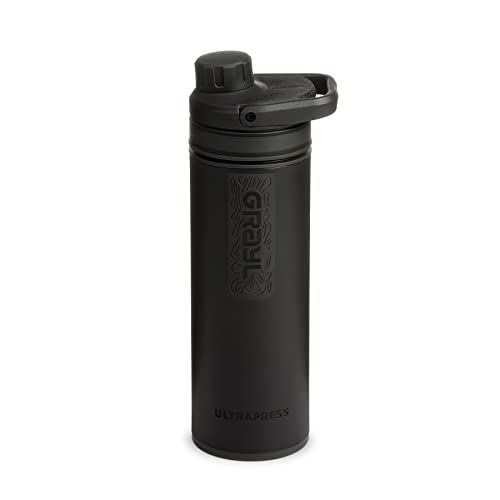
The GRAYL UltraPress focuses on global pathogen purification. It removes viruses (such as rotavirus and norovirus), bacteria (including E. coli and Salmonella), and protozoa. In addition to disinfection, it filters particulates and adsorbs VOCs, PFAS, chemicals, pesticides, heavy metals, and odors. Its compact 16.9-ounce size is designed for quick trips, emergency kits, or travelers who prioritize robust protection against sketchy water sources encountered in hiking, backpacking, or international travel.
Buying Guide
- Filtration vs. purification: If you travel internationally or to regions with uncertain water quality, prioritize purification bottles that remove viruses, bacteria, parasites, and microplastics (e.g., GRAYL and LifeStraw models). If your sources are primarily municipal, a high-quality taste-improvement bottle (like Brita) may suffice, though it is not a purifier.
- Filtration technology: Look for dual-stage systems that combine carbon filtration and membrane microfiltration. Carbon helps with taste and odor, while microfiltration targets pathogens and microplastics.
- Capacity: 1 L options are great for group travel or extended walks, while 22 oz bottles fit easily in a backpack side pocket. Consider your typical trip length and refill opportunities when choosing capacity.
- Weight and portability: Stainless steel bottles offer durability and insulation but can be heavier. Plastic options are lighter but may require care to avoid dents or heat damage. Consider how the bottle will ride in a daypack, carry-on, or travel bag.
- Durability and build quality: A secure lid, leak-proof seals, and robust filters matter for travel. Check for BPA-free materials and the availability of replacement filters on appximate replacement cycles.
- Replacement filters and lifecycle: Some bottles require frequent filter changes (e.g., every 2 months or 40 gallons for Brita), while others offer longer lifespans. Factor in access to replacement filters when you travel frequently.
- Maintenance: Look for models with simple cleaning options and clear instructions. Bottles with removable parts may require more time for thorough cleaning after exposure to high-contaminant sources.
- Use-case variety: If you need a bottle for hiking, business travel, and camping, prioritize models that are compact, easy to use, and provide dependable purification across varied water sources.
- Environmental impact: Reusable bottles reduce plastic waste. Compare life-cycle costs, filter replacements, and the number of single-use bottles avoided to gauge environmental benefits.
- Pricing and availability: While prices vary, focus on total cost of ownership: initial bottle price plus replacement filters over your expected travel period.