Disclosure: As an Amazon Associate I earn from qualifying purchases.
A cold-water bottle has to work during the ordinary moments of your day: fitting beside you on a commute, opening at a desk, carrying enough water between refills, and being straightforward to clean that evening. A long advertised cold-retention time is useful information, but it cannot tell you whether the lid suits you or whether the filled bottle fits your bag.
The original options in this guide include vacuum-insulated steel bottles and a larger foam-insulated THERMOS jug. Their capacities and drinking arrangements differ. These are comparisons of documented configurations, not reports of personal temperature tests. Treat insulation duration and leak-resistance statements as manufacturer claims with conditions, then make the purchase around your actual route, refill opportunities, and care routine.
Choose the drinking arrangement before choosing the largest bottle
Decide whether you want to pour water into a cup, drink through a covered spout, use a straw, or remove a screw lid. Each arrangement creates a different everyday routine. A serving-cup flask can be convenient during a pause but less convenient than a direct-drinking bottle when you simply want a sip at a desk.
Think about where opening the bottle happens. A lid that is easy to use while standing still may be inconvenient when both hands are occupied. That does not make another closure universally better. Match the access style to the circumstances in which you can stop and drink, including any rules in your workplace or vehicle.
Next consider the time between dependable refill points. A larger jug is worth carrying when its extra capacity solves a real gap. If you can refill frequently, a smaller bottle may be easier to fit and carry. Capacity is a container choice, not a personalized prescription for how much water everyone should drink.
The five original bottles and the trade-offs that matter
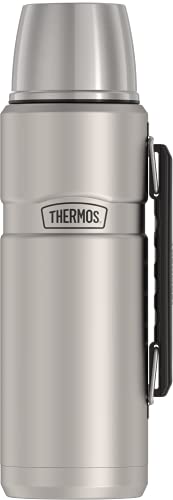
THERMOS Stainless King 40 oz: a flask with a serving cup
ASIN B01DZQT3IU identifies the forty-ounce THERMOS Stainless King beverage bottle. This is the vacuum-insulated steel flask direction, with a carrying handle, a serving-cup lid, and a twist-and-pour stopper. The manufacturer’s forty-ounce product page documents that arrangement and advertises up to twenty-four hours of cold retention; that is a maker claim rather than a temperature result measured for this guide.
Consider it when you prefer pouring water during planned breaks and want a larger flask than a compact personal bottle. The cup is a useful distinction if you will use it, but it also means another surface to clean and a different drinking routine from a covered spout. Check the stopper instructions before assuming it must be fully removed to pour.
Before buying: compare filled carrying weight, height, and where the handle and cup will fit. Do not assume it fits a vehicle cup holder. Choose its serving arrangement and capacity because they suit your day, not because an advertised duration guarantees a particular temperature after repeated opening.
View this selected option on Amazon
THERMOS ICON 24 oz: direct access through a covered spout
The original ICON option, ASIN B0C2RZWTQT, is a twenty-four-ounce steel water bottle with vacuum insulation, a covered drinking spout, and a locking ring. Its manufacturer product description identifies the wide mouth and the spout arrangement and explicitly says this version is not for hot liquids. A steel body does not override that lid-specific restriction.
Consider it when you want direct drinking access rather than pouring into a separate cup. The covered spout may appeal for keeping the drinking surface covered between uses, but it is not proof that the bottle prevents contamination. The locking arrangement also deserves a close look if the bottle will be packed beside other belongings.
Before buying: inspect how the lid opens, how the lock works, and which parts require separate cleaning. Check the selected bottle’s base dimensions against your holder rather than relying on a generic compatibility statement. This is a cold-water candidate with a specific closure, not an interchangeable hot-and-cold flask for every use.

View this selected option on Amazon
THERMOS 64 oz foam-insulated jug: capacity takes priority
ASIN B00WUF6KWK identifies the Charcoal sixty-four-ounce THERMOS hydration bottle with a flip-up spout, locking latch, and integrated handle. The exact listing specifies double-wall foam insulation. It should not be described as the same insulation system as the steel vacuum bottles elsewhere in this guide, and their advertised retention times cannot be borrowed for it.
Consider it when carrying a larger amount of water between refills matters more than fitting a narrow bottle pocket. Its jug format and handle create a different transport arrangement from a smaller direct-drinking bottle. Compare the filled container with the space available at your destination, including where it will sit when you need both hands free.
Before buying: confirm the selected sixty-four-ounce version, lid-care directions, and the actual dimensions. Do not assume foam construction establishes lower filled weight, equal thermal performance, or the same dishwasher instructions as a Stainless King or ICON model. The capacity and access format are its reasons to shortlist, with insulation expectations kept separate.
View this selected option on Amazon
POWCAN 26 oz: a choice between straw and spout access
The original POWCAN option, ASIN B0D8J2ZB8P, is the twenty-six-fluid-ounce bottle in Dark Knight. Its listing describes a two-in-one lid offering straw and spout access and a double-wall insulated steel body. That choice of drinking routes is more useful for comparison than a general claim that the bottle suits every sport or travel situation.
Consider it if you genuinely expect to use both access styles. Otherwise, extra lid components may add cleaning work without solving a daily problem. Check how the straw connects and whether the opening you prefer can be closed as directed. A feature list does not establish how easy those parts will be for you to manage.
Before buying: verify which lid and straw come with the selected size, along with cleaning and replacement-part information. Measure the actual holder you intend to use; “standard cup holder” is not a universal dimension. Advertised cold duration and leak resistance are listing claims, not permission to assume every closure setting is suitable for carrying the bottle loose in a bag.

View this selected option on Amazon
PARACITY 15 oz: the smaller original linked option
ASIN B0C1BZ14ZQ currently identifies a black fifteen-fluid-ounce PARACITY insulated steel bottle. Use that selected capacity when planning refills rather than borrowing a larger variant’s figure. The listing describes double-wall vacuum insulation and a sealing ring in the lid. Its compact-capacity role is the main distinction from the larger original options.
Consider it when you have convenient refill access and want to carry a smaller amount at a time. Check the actual exterior dimensions before deciding that it fits a pocket or bag. A small stated capacity does not establish the outside diameter, and a steel construction claim does not guarantee that water will never develop an unwanted taste.
Before buying: confirm the fifteen-ounce selection and the washing directions for both lid and body. This guide does not treat the listing’s IPX7 language as independent certification or approval for a particular cleaning method. Advertised temperature duration and leak resistance remain claims to evaluate under the supplied instructions, rather than guarantees for every journey.

View this selected option on Amazon
Work out capacity from your refill route
Make a simple map of an ordinary day: where you leave, where you stop, and where you can reliably obtain drinking water. Compare a normal day with the longer outing that happens occasionally. If those situations differ greatly, one oversized container may be an awkward compromise rather than the most convenient everyday purchase.
Record your own usual refill routine instead of adopting a blanket hydration target from a product review. Needs vary, and a bottle comparison cannot provide personalized medical guidance. For shopping, you need to know whether the container’s capacity and access style suit your existing plan and whether refilling is realistically available.
Leave room in that plan for ice if you use it. Ice occupies space that would otherwise hold liquid, and the bottle’s full nominal volume does not describe every possible ice-and-water mixture. You do not need a complicated conversion table: compare how you actually fill a bottle and how frequently you expect to refill it.
Then consider the carrying burden. A jug with a handle may work well between a car and a fixed workspace but be less convenient on a crowded walk. A smaller bottle can fit into more places yet need more refills. Neither trade-off can be settled by capacity alone.
- Desk and nearby refill: prioritize a comfortable drinking arrangement, a stable place to put the bottle, and cleaning access.
- Commute with few stops: compare usable capacity, filled carrying weight, closure operation, and bag or holder measurements.
- Longer stationary activity: investigate whether a handled jug solves the refill gap and where it can be placed.
- Small bag or pocket: confirm actual exterior dimensions rather than inferring fit from ounces.
Understand the cold-retention claim you are comparing
An insulated container slows changes in temperature; it does not refrigerate warm water. Starting with the water temperature you want matters. A claim expressed as “up to” a number of hours should not be read as a promise that any starting water temperature will stay equally cold for the whole period.
Look for the conditions behind the advertised figure if that duration is important to you. Initial temperature, ambient conditions, filling level, ice, and how often the bottle is opened can change the situation. A duration without a stated temperature threshold is also difficult to compare directly with another brand’s duration.
Avoid treating foam and vacuum insulation as a simple guarantee of equal performance or a universal ranking. The original THERMOS jug and the vacuum bottles use different designs. Without comparable test conditions, their descriptions do not establish exactly how many hours of difference you would observe on your own route.
Evaluate the routine you need instead of chasing the longest number. For a workday with refills, closure access and cleaning may matter more than a claim extending far beyond your actual use. For an outing without refills, begin with capacity and credible usage instructions, then assess whether the advertised retention information addresses that setting.
Measure the places where the bottle must fit
Take the dimensions of your holder, bag pocket, and storage shelf before ordering. A holder’s opening diameter, usable depth, and nearby obstructions all matter. A carry handle or protruding lid can interfere even when the cylindrical body appears narrow enough.
If you use a vehicle cup holder, compare the actual bottle base with that specific holder. Different vehicles and adjustable inserts create different usable sizes. Do not expect an assurance such as “fits standard cup holders” to resolve the fit of a forty-ounce flask or sixty-four-ounce jug.
For a backpack, inspect the pocket depth and how securely it retains a filled container during your normal movements. Consider whether the lid or handle catches when removing the bottle. A bottle that technically fits may still be frustrating to use if it needs to be lifted past another object every time.
Think about how the bottle will stand at the destination. A clear place on a desk or bench is more useful than a vague assumption that a particular base coating prevents every fall. A grip surface is a design feature, not a guarantee that the bottle cannot tip, slide, or damage a delicate surface.
Lids and seals: practical questions that advertisements skip
Identify all the components that come into contact with water: stopper, spout, straw, sealing ring, and any channels inside the lid. Check whether each is removable for cleaning and whether the manufacturer supplies instructions for reassembly. A simple-looking lid can still contain areas that deserve attention.
Consider which closure state is intended for transport. A spout used for drinking may need a separate cover or lock engaged before carrying. A serving stopper can have more than one position. Follow the actual directions rather than assuming an advertised leak-resistant bottle is closed whenever the cap appears to be attached.
If the bottle will be carried beside electronics or paper, assess that consequence before choosing the storage arrangement. Inspect the seal and follow the closure instructions; do not turn a listing’s leak-proof wording into a guarantee that every lid setting or worn gasket will protect nearby belongings. A separate upright pocket may be a more practical arrangement for your routine.
Replacement availability is worth checking before purchase. The correct gasket, stopper, or lid must match the bottle model, not merely its nominal capacity. A similarly sized lid from another series may use different threads or sealing surfaces. Avoid treating mixed-brand accessories as interchangeable unless compatibility is established.
A cleaning routine you can repeat
Choose a bottle whose drinking parts you can access and care for according to its instructions. The opening should accommodate your permitted cleaning method, not just the ice you want to add. Consider how you will reach the bottom and how small removable pieces will be kept together while drying.
Read body and lid washing directions separately. Dishwasher approval for one part does not establish approval for all components, and top-rack guidance is not the same as unrestricted placement. The two THERMOS vacuum models have their own maker instructions; their care information should not be applied automatically to the foam jug or other brands.
Do not interpret a waterproof rating in a sales description as a washing protocol. It does not identify suitable detergents, dishwasher temperatures, or whether a lid should be dismantled. Use the bottle’s supplied care guidance, and seek the correct instructions if those directions are missing.
Cold-water use does not mean a lid stays clean indefinitely. Empty, clean, and dry the bottle as directed rather than repeatedly topping it up without examining the drinking parts. If water develops an unfamiliar odor or taste, address the condition and cleaning requirements instead of assuming the insulation system establishes hygiene.
Keep cleaning tools and products compatible with the actual materials. Avoid substituting aggressive chemicals or improvised treatments for the maker’s instructions. A maintenance routine that requires more time than you will realistically give it is a reason to reconsider the closure, even if its advertised features initially seem attractive.
Match the bottle to three real situations
A desk bottle with frequent refills
Start with direct-drinking access and a size that leaves usable desk space. The ICON’s covered spout and POWCAN’s two-in-one arrangement provide different choices. Compare which opening you will use and clean most consistently; do not assume the more complicated lid is more convenient for your particular workday.
The smaller PARACITY can be a reasonable direction when refill access is dependable. Its capacity is not a reason to claim it suits every long outing. Think through whether you will be willing to refill it during a busy day, rather than buying around a theoretical opportunity you often miss.
Planned breaks on a longer journey
The Stainless King serving cup may make sense if you stop to pour and drink. Check where the flask is carried and where the cup will be placed during use. That arrangement can be useful without being the most convenient direct-sipping solution.
If your route has a long gap between refill points, compare the jug’s extra capacity with the practical carrying space. Its handle does not eliminate the weight of the water. Keep the insulation type distinct when deciding whether the foam jug addresses your expectations.
A gym bag or shared changing area
Prioritize a closure you can operate as directed and a place to store the bottle without disrupting other belongings. Look at spout coverage, sealing parts, and cleaning access. A claim that a lid is hygienic does not replace ordinary care or make the bottle suitable for sharing between users without cleaning.
A checkout checklist that protects against variant mistakes
Save the selected capacity, color, lid type, and exact product name in your order record. Check those selections again when the bottle arrives. Product families can offer several capacities and different closures under similar names, so a photo of the same brand is insufficient confirmation.
Compare the delivered parts with the stated package contents before discarding packaging. If the wrong lid or capacity arrives, resolve the order discrepancy rather than treating it as a minor cosmetic variation. Keep the supplied care instructions and the seller’s actual return information with that record.
Is twenty-four-hour cold retention a required feature?
Only if it addresses your actual routine, and only when you understand the claim’s conditions. For shorter days with refills, fit, access, capacity, and cleaning can be more useful deciding factors. No duration in this guide is a personal temperature-test result.
Can a cold-water bottle also hold hot drinks?
Check the exact product and closure. The ICON spout model here is explicitly not for hot liquids. Do not assume every insulated steel bottle has the same permitted use simply because another flask from the same brand handles hot beverages.
Should I buy the biggest size to avoid future regret?
Choose the capacity you can use and carry conveniently. A larger container can solve a refill gap, but it can also create a fit or storage problem. The right purchase is the one that works through your ordinary day, including filling, drinking, carrying, and cleaning.