One-handed cooking tools are designed to help anyone with limited grip strength or mobility prepare meals more easily. This guide focuses on adaptive boards, knives, and jar openers that enable safer, more controlled foods prep with minimal effort. The top picks below are tailored for seniors, stroke patients, amputees, and anyone recovering from injury who still wants independence in the kitchen.
Summary of selected products:
| Product | Best For | Key Feature |
|---|---|---|
| Ziliny One-handed Cutting Board Set | Stroke patients, arthritis sufferers | Ulu knife with stability spikes and suction base |
| Cook-Helper One-Handed Gadget (Set) | Anyone needing effortless jar/bottle openings | Sticky mat grips for one-handed operation |
| SENDAR Adaptive Cutting Board With Spikes | Disabled, elderly, one-handed prep | 10 spikes and raised rear fence for spill prevention |
| GREENANTS Ergonomic Adaptive Knife | Arthritis and limited grip users | Angled handle for one-handed rocking cut |
| Etac Fix Preparation Board | Anyone needing reliable grip and adjustable jaws | Non-slip base with stainless spikes and adjustable jaws |
Ziliny One-handed Cutting Board Set with Ulu Knife

The Ziliny set combines a stable adaptive cutting board with a one-handed Ulu knife. Best for seniors, arthritis sufferers, or someone recovering from surgery, this kit uses powerful suction cups to secure the board and 10 food-grade spikes to hold foods in place. A beveled edge allows smooth one-handed transfer of chopped items to a plate. The curved blade and ergonomic birch handle support rocking cuts with reduced wrist strain. Choose this for controlled, one-handed prep that minimizes slipping.
Best for: one-handed cooks who want stability and edge-to-plate transfer in a single setup. Limitation: board size requires ample counter space; ensure your workspace is smooth for suction reliability.
Cook-Helper One-Handed Gadget Bundle

This compact trio focuses on securing containers and opening jars with one hand. The soft, sticky mat grips jars, bottles, and cans without installation, reducing wrist strain and movement. It’s portable, easy to clean, and suitable for kids to seniors. It excels for tasks like opening lids, pouring, and stabilizing containers during one-handed operations. Best for: users who need a portable, simple solution to reduce grip effort in daily routines. Limitation: not a full kitchen prep station—best as a complement to other tools.
SENDAR Adaptive Cutting Board With 10 Spikes

This board features a stable base with non-slip feet and 10 spikes to hold items securely, making one-handed cutting feasible for stroke patients, elderly users, and disabled individuals. The raised rear fence helps prevent spills and simplifies scooping. Best for: those needing a robust one-handed cutting solution with secure food anchoring. Limitation: traditional chopping boards may feel wide; ensure adequate counter space.
GREENANTS Angled Adaptive Kitchen Knife

This ergonomic knife is designed for independence with an angled handle that enables a natural downward rocking motion. It’s ideal for arthritis and limited grip strength, letting users slice meat, vegetables, and bread with less effort. A protective blade cover aids storage and safety. Best for: one-handed users who want a safer, easier cutting motion. Limitation: edge protection adds a storage component; remove during use.
Etac Fix Preparation Board
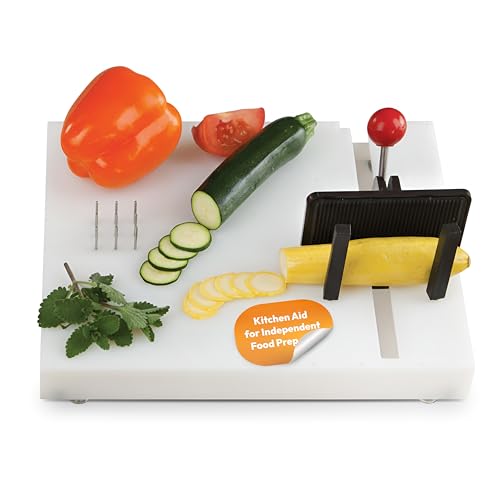
Etac Fix provides a secure cutting surface with stainless steel spikes and adjustable jaws. It is built for one-handed use and includes non-slip feet and suction cups to anchor the board. This product is designed for stable handling while slicing or peeling, making kitchen tasks more manageable for users with limited mobility. Best for: those who need adjustable jaw grip and strong, reliable stability. Limitation: higher price point may be a consideration for budget-focused buyers.
Buying Guide: Key Considerations For One-Handed Cooking Tools
Who should consider these tools? People with arthritis, stroke recovery, reduced grip strength, amputations, or other mobility limitations. When selecting, prioritize stability, ease of use, and the specific task you perform most often in the kitchen.
- Stability and grip: Look for non-slip bases, suction cups, and spikes that secure food without extra effort. A raised fence or back edge helps with spills and scooping.
- One-handed suitability: Choose tools designed for rocking or sliding motions rather than traditional up-down movements.
- Ease of cleaning: Removable parts and dishwasher-safe components save time and maintain hygiene.
- Safety features: Blade covers and protective edges reduce risk when not in use.
- Space and portability: Compact, lightweight devices travel well or store easily in a small kitchen.
How to combine tools for best results
- Pair a secure cutting board with a one-handed knife for a complete prep station.
- Use a jar-opening mat alongside a cutting board to minimize hand strain on top-of-counter tasks.
- Keep a dedicated adaptive tool set near the primary prep area to reduce movement and improve efficiency.
Maintenance tips
- Regularly inspect spikes and edges for wear; replace if sharpness or grip is compromised.
- Clean suction bases after use to maintain suction power.
- Store protective blade covers separately to prevent accidental contact.
FAQ
- What is the primary benefit of one-handed cutting boards?
– They provide stability, reduce wrist strain, and allow safe cutting with a single hand by anchoring food and offering guided cuts.” - Are these tools suitable for all kitchens?
– Yes, many are compact and portable, designed to fit standard countertops and dishwashers; some require extra counter space for stability. - Do these tools require special maintenance?
– Most are easy to clean; keep spikes and edges dry and inspect for wear regularly. - Which tool should I start with if I have arthritis?
– Start with an angled knife or a cutting board with non-slip footing to minimize grip effort and improve control. - Can these tools help after a stroke?
– They can assist with independence in meal prep by reducing the need for two-handed coordination. - Are there risks using adaptive tools?
– Proper use reduces strain, but avoid forcing motions that cause pain; consult a clinician if unsure.