Answering the common search: choose a dedicated mixing bottle that delivers accurate ratios, prevents spills, and withstands fuel exposure. This guide spotlights top options for different buyers, from casual homeowners to workshop pros. Each product is evaluated for best use case, reliability, and ease of use. The table below highlights five strong choices to consider at a glance.
| Product | Best For | Capacity |
|---|---|---|
| Attwood Fuel and Oil Mixing Bottle 1 Quart Wide Mouth | Boat owners and marine enthusiasts | 1 quart |
| 2 Stroke Gas Petrol Fuel Oil Mixing Bottle, 1L | General 2-stroke maintenance | 1 liter |
| Maxima Racing Oils 10920 Quick-2-Mix | Precision users needing wide ratio range | 20 oz |
| Mixing Bottle for Loading 2 Stroke Engines (4 Ratios) | Varied engines, small workshop | 1 liter |
| Spertek Fuel & Oil Mixing Bottle | Brands compatibility (Stihl, Husqvarna, etc.) | 1 liter |
Attwood Fuel and Oil Mixing Bottle 1 Quart Wide Mouth
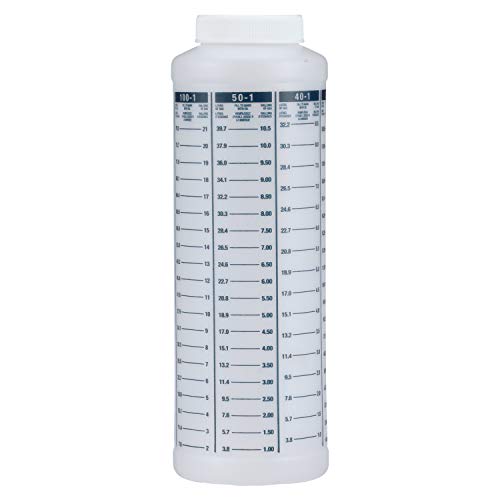
The Attwood bottle is designed for precise fuel-to-oil ratios with clearly marked measurements. It features a wide-mouth design to simplify filling, pouring, and mixing, reducing mess and guesswork before hitting the water. Best for boaters who need quick, accurate mixing on deck or in the garage. A potential limitation is the absence of a multi-ratio chart beyond standard markers, so verify your engine’s exact specification before use.
2 Stroke Gas Petrol Fuel Oil Mixing Bottle, 1L

This 1-liter bottle is tailored for two-stroke engines with multiple preset ratios (32:1/50:1/40:1/25:1). It’s compact and handy for field service or small shops. Best for users who need a straightforward, portable option for multiple engines. A caveat: the product listing emphasizes multiple ratios but does not guarantee a printed chart on the bottle itself, so users should rely on their engine’s manual for exact numbers.
Maxima Racing Oils 10920 Quick-2-Mix
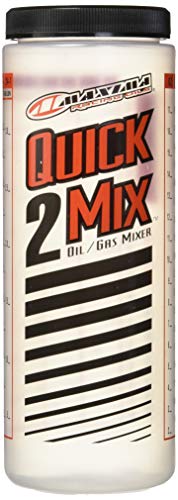
The Maxima Quick-2-Mix bottle is calibrated to mix in ratios from 24:1 to 100:1, with built-in calibrations for ounces, cubic centimeters, gallons, and liters. This makes it a strong choice for serious users who need precise ratios across a wide range of engines. Choose this if you value long-term accuracy and metric/imperial versatility. Limitation: it may be less intuitive for beginners who only need common ratios.
Mixing Bottle for Loading 2 Stroke Engines (4 Ratios)
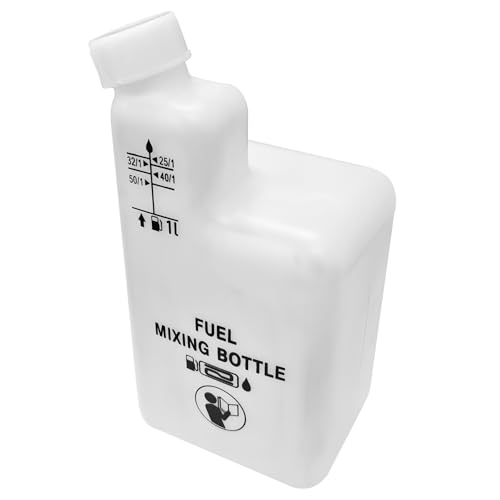
This bottle provides four precise ratios (32:1, 50:1, 40:1, 25:1) and a 1L capacity. It’s designed to be durable, resistant to oil stains, and resistant to chemical corrosion, with clear scale markings to reduce confusion. Best for those who work with multiple 2-stroke machines such as lawn equipment and small engines. Limitation: some users may prefer a larger capacity for bigger engines or boats.
Spertek Fuel & Oil Mixing Bottle for 2 Stroke

The Spertek bottle is compatible with a broad range of brands, including Stihl and Husqvarna, and features a 1-liter capacity with a standard 50:1, 40:1, 32:1, and 25:1 mix. This makes it a versatile option for mixed-brand tool kits. Best for multi-brand users who want a single bottle for diverse equipment. Caution: ensure your chosen ratio matches your tool’s requirement to avoid over- or under-oiling.
Buying Guide: How to Choose the Right 2-Stroke Mixing Bottle
Key considerations help you pick a bottle that matches your engines, usage, and workspace. Use these practical questions to compare options:
- What ratios does your engine require? Look for bottles with the exact ratios you use most, or ones with a wide range to future-proof.
- What capacity fits your workload? Small tools may only need 1 L or 1 quart, while boats or workshop use may benefit from larger sizes.
- Is the bottle easy to fill and pour? A wide-mouth design reduces spills and makes measuring straightforward.
- Are scale markings clear and durable? Chemical-resistant, permanent markings prevent misreads under fuel exposure.
- Is the bottle compatible with your maintenance needs? Some bottles include multi-brand compatibility for workshop versatility.
- Will it last in a shop or garage environment? Look for materials that resist oil stains and corrosion and resist cracking from drops.
Practical tips for using a mixing bottle
- Always measure oil first, then add gasoline to the indicated mark to avoid errors.
- Rinse the bottle after use to prevent residue buildup that could skew future ratios.
- Label the bottle with your usual engine mix to avoid cross-use errors in the field.
FAQ
- Why use a dedicated oil-to-gas mixing bottle?
It ensures precise ratios, reduces spills, and keeps fuel clean for 2-stroke engines. - What is the most common ratio for 2-stroke engines?
Typical ratios are 25:1, 32:1, 40:1, and 50:1, depending on engine design and manufacturer. - Can these bottles be used for boats and lawn equipment alike?
Yes, many are designed for broad compatibility, but always match ratios to your specific tool. - What material should I look for?
Durable, chemical-resistant plastics that resist oil staining and won’t crack from drops. - Is a larger bottle always better?
Not always; choose a capacity that matches your workload to avoid bulk and reduce waste. - Do these bottles include ratio charts?
Some do; others require you to know your ratios or reference your engine manual for exact numbers.