Looking for a kitchen scale load cell kit that’s easy to wire, accurate, and compatible with common microcontrollers like Arduino or Raspberry Pi? The top options below are designed for DIY enthusiasts and small electronics projects. Each pick targets a different weighing range, so you can choose based on capacity, form factor, and intended use—whether you’re building a compact kitchen scale, a portable food scale, or a bench-scale project. The list highlights who each product is best for and why, plus practical caveats to consider before buying.
Summary of chosen products
| Product | Capacity | Best For | Notes |
|---|---|---|---|
| ShangHJ 4 Sets Digital Load Cell + HX711 (1kg) | 1 kg | Compact kitchen scales and beginner Arduino projects | Highest precision in small range; 4-set kit for hardware versatility |
| 2 Sets Digital Load Cell + HX711 (5kg) | 5 kg | Mid-range DIY scales and portable kitchen projects | Balanced capacity and ease of use |
| ShangHJ 4 Sets Digital Load Cell + HX711 (5kg) | 5 kg | Better for heavier ingredients and robust builds | Similar kit with a larger range |
| ShangHJ 2 Sets Digital Load Cell + HX711 (10kg) | 10 kg | Higher-capacity DIY scales and hobby projects | Greater load tolerance; suitable for bulk items |
| Wishiot 4sets Load Cell Kit (1kg/5kg/10kg/20kg options) | Multiple options | Versatile family or classroom kits | Multiple weight options in one set |
ShangHJ 1kg Digital Load Cell Kit With HX711

The kit includes a 1 kg load cell with an HX711 ADC module and wiring instructions. The load cell uses four leads: red to E+, black to E-, green to A+, white to A-. The system requires a 5–10 V drive voltage and outputs a voltage signal proportional to force changes. It’s compatible with Arduino and Raspberry Pi for straightforward data collection. Best for beginners building a compact kitchen scale or small desk-scale prototype.
Who it’s best for: hobbyists starting with a low-capacity scale project or educational kits. Caution: the 1 kg limit means it’s not ideal for heavier ingredients; accuracy can depend on stable power and proper calibration.
2 Sets 5kg Digital Load Cell + HX711 Kit
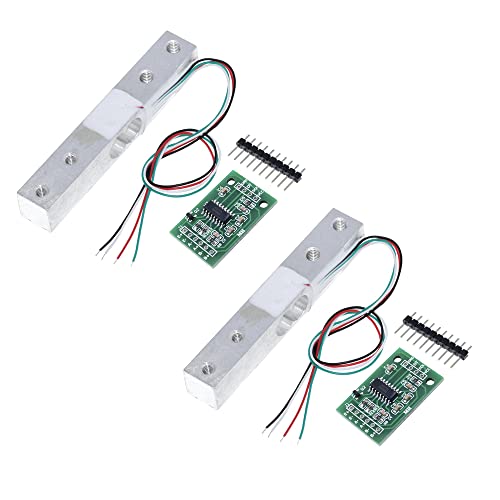
This set uses a 5 kg load cell with four-wire connections to an HX711 module. The included wiring follows the same red to E+, black to E-, green to A+, white to A-, and requires 5–10 V supply. It’s compatible with Arduino and Raspberry Pi, making it suitable for medium-capacity kitchen scales and portable measuring devices. Best for users who need a mid-range capacity without complexity.
Best for: balanced capacity projects and learners upgrading from 1 kg kits. Limitation: 5 kg may still miss larger quantities; ensure calibration matches your intended loads.
ShangHJ 5kg 4 Sets Load Cell + HX711 Kit
This kit extends capability to 5 kg, using four-lead connections and an HX711 ADC module. It follows the same wiring pattern with power requirements of 5–10 V. The package is well-suited for more robust kitchen tasks or small equipment projects that demand higher load tolerance. Best for projects that require slightly higher capacity without moving to bulk-scale hardware.
Choose this if you anticipate heavier ingredients or need a sturdier build. Limitation: similar to other HX711-based kits, performance depends on stable calibration and temperature effects on load cells.
ShangHJ 10kg Digital Load Cell Kit
Designed for higher load projects, this 10 kg kit uses a four-lead configuration and HX711 module for data conversion. The greater capacity suits bulk ingredient weighing or larger DIY scales. It remains compatible with Arduino and Raspberry Pi for straightforward integration. Best for projects that require a heavier measurement range but still want a compact, kit-based approach.
Better for: bulk food weighing or prototyping higher-capacity scales. Limitation: higher capacity can come with slightly less precision at the top end if not properly calibrated.
Wishiot 4sets Load Cell Kit (1kg, 5kg, 10kg, 20kg Options)

This kit offers four set weights per package and includes an HX711 A/D module. Weight options cover 1 kg, 5 kg, 10 kg, and 20 kg, providing flexibility for multiple projects without buying separate kits. The wiring follows the standard red to E+, black to E-, green to A+, white to A-. Best for classrooms, labs, or makers who want a single purchase covering several capacities.
Caution: Ensure you select the correct weight option for your project to avoid underestimating loads or overloading the scale during use.
Wishiot 1kg/5kg/10kg/20kg Mini Load Cells Kit

Available in 1 kg, 5 kg, 10 kg, and 20 kg variants, this Wishiot kit supports four-lead connections to the HX711 and requires a 5–10 V supply. It’s suited for educators or developers who want precise control over load range for multiple mini projects. Best for modular building and experiments that require swapping load cells without changing the main electronics.
Limitations: select the correct capacity before purchasing; misalignment with project needs can reduce measurement usefulness.
Wishiot 2 Sets 10kg Kit For DIY Kitchen Scale

This kit focuses on a higher capacity with two load cell sets and HX711 ADCs. The standard four-wire connection (red to E+, black to E-, green to A+, white to A-) remains, with 5–10 V drive voltage. Best for users building mid-to-high capacity scales or as a starter for more robust DIY weighing systems.
Better for: scalable hobby projects needing reliable 10 kg range. Caution: ensure your frame and mounting can handle the load and calibration stability across repeated use.
Geekstory 5kg Dual Load Cell Pack

Geekstory offers a pack of two 5 kg load cells with an HX711 module option. The construction uses aluminum alloy with a parallel beam design, designed for electronic kitchen scales and similar small appliances. The four-lead wiring pattern remains consistent with other kits. Best for users seeking small, precise scales with a sturdy build.
Limitation: aluminum construction can be sensitive to mechanical stress; ensure mount robustness to maintain accuracy over time.
Buying Guide
- What capacity range do I need? Choose a kit whose maximum load matches your typical weighing tasks. 1 kg options are compact but limited; 5 kg and 10 kg are flexible for most home-scale projects; 20 kg suits bulk items or larger prototypes.
- Will I use Arduino or Raspberry Pi? All listed kits are designed for common microcontrollers. Confirm available libraries or sample wiring diagrams match your board and language preferences.
- How important is calibration? Load cells require proper calibration against known weights to ensure accuracy. Plan for a calibration process during initial setup and periodic checks during use.
- How many load cells will I mount? Some kits include multiple cells for strength and redundancy. If building a wider scale, ensure your frame supports multiple cells and even load distribution.
- What about power? Most kits require a 5–10 V supply. Ensure your power source is stable to minimize drift during measurements.
- Mounting and enclosure considerations? A rigid, temperature-stable housing improves measurement accuracy. Consider vibration, airflow, and mounting hardware when designing your scale.
FAQ
- What is a load cell and HX711 used for? A load cell measures force, and the HX711 converts the analog signal to digital data for microcontrollers to read.
- Can I use these kits with Arduino? Yes, all listed kits are designed for Arduino and similar platforms, with standard wiring (red to E+, black to E-, green to A+, white to A-).
- Do I need any special software? Most projects use simple examples or libraries to read raw data and apply calibration curves.
- Is a higher capacity always better? Not necessarily. Choose capacity based on expected loads; too high capacity can reduce sensitivity for small weights unless the scale is well-calibrated.
- Are multiple load cells necessary? For compact kitchen scales, a single load cell is common. Dual or multiple cells are used for larger platforms or to improve stability and accuracy.
- What maintenance is required? Regular calibration and inspection of the mounting hardware help maintain accuracy over time.