In this guide Jump to a section
- Keep the measurement attached to its unit
- Begin with a real meal instead of a household label
- Ask exactly what the capacity number means
- Look for a minimum as well as a maximum
- Distinguish volume from usable cooking area
- Make a batch clock for a weeknight
- Include the rest of the package in your decision
- Build a two-person comparison with honest blanks
- Translate a label into a useful question
When you cook for two, read appliance capacity as a description of what was measured, not a promise about how many dinners fit. A rice cooker’s cup count, an air fryer’s quart label, and a blender jar’s volume answer different questions.
Your useful question is smaller and more practical: can this exact appliance make the amount and type of food you regularly prepare, within its instructions, without forcing you into an awkward second batch?
Keep the measurement attached to its unit
| Label you see | What to verify | What it does not settle |
|---|---|---|
| Rice-cooker cups | Included cup definition and raw-rice limit | Your mug size or cooked serving count |
| Jar liters | Permitted working fill for the mixture | Every blending task at that volume |
| Oven or basket volume | Usable food arrangement and approved accessories | An unlimited number of stacked layers |
Begin with a real meal instead of a household label
Write down three ordinary meals you cook together, including the amount you actually serve. “Dinner for two” could mean two modest side portions of rice or a full meal with generous leftovers.
Choose one representative recipe and note its uncooked quantities. If you regularly double that recipe for lunch the next day, keep that larger batch visible rather than assuming a small household always needs the smallest machine.
Now mark which parts of the meal you expect one appliance to handle. Cooking the vegetables in an air fryer while you cook chicken elsewhere is different from expecting the same basket to hold the entire dinner.
This short meal list gives you a basis for comparison that a product’s suggested serving count cannot provide. You are matching a tool to your food, rather than changing dinner to suit a label.

Ask exactly what the capacity number means
Read the sentence or footnote beside the advertised capacity. Look for whether the number describes dry ingredients, cooked food, total vessel volume, maximum liquid fill, or another specific measurement.
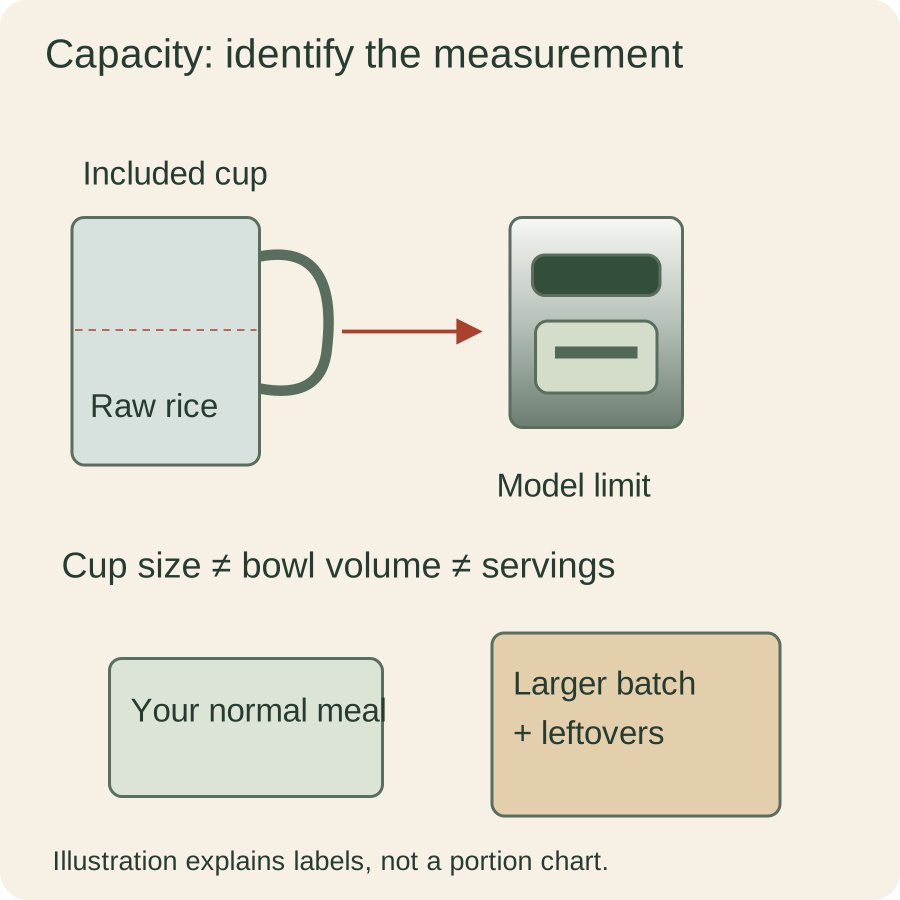
Zojirushi explains that its rice-cooker capacities refer to maximum amounts of raw short-grain white rice measured with the included cup. It also notes that capacity for other rice types can differ.
The company describes that rice cup as approximately 180 mL, rather than a standard US measuring cup. That is why comparing two machines by their cup numbers alone can lead you away from the amount you meant to cook.
Keep the unit’s meaning next to the number in your shopping notes. “Three included cups of raw rice” is a more useful entry than simply writing “three cups.”
For a blender, separate jar volume from its marked working limit for your task. Follow the exact instructions for hot liquids or other restricted uses instead of assuming the jar can always be filled to its rim.
Look for a minimum as well as a maximum
A maximum tells you when a machine is full, but your normal dinner may sit at the other end of its range. Search the manual for the smallest supported batch and any instructions that change with small quantities.
For example, a bowl can look admirably spacious while leaving a tiny amount of food awkward to reach with its attachment. That is a reason to inspect the manufacturer’s actual small-batch guidance, not evidence that the product is poorly made.
If the documentation does not answer your normal small-quantity question, ask the manufacturer before buying. Give the exact model and a concrete example, such as the amount of sauce or dough you want to prepare.
Do not turn an unanswered minimum into a confident recommendation based on a photograph. A broad product description cannot show how an attachment interacts with the quantity at the bottom of the bowl.
Distinguish volume from usable cooking area
For food that needs space across a tray or basket, an overhead view can be more useful than a quart number. Inspect the actual basket or rack dimensions when the manufacturer provides them.
Lay your usual food portions on a sheet of paper the size of the usable area. This is a fit exercise, not a cooking test, but it reveals whether your expectations depend on stacking or squeezing things together.
Count a second rack only when the manual supports the arrangement and the cooking method you intend to use. Do not assume every included accessory creates an extra independent cooking surface for every recipe.
Keep the shape in mind as well as its area. A long fillet, a round baking dish, and a group of small vegetables make very different demands on the same rectangular basket.
For a concrete comparison, sketch an eight-inch square and a ten-by-six-inch rectangle. Their layouts feel different even before you place a food-shaped outline on each one, which is exactly why a single volume number leaves questions unanswered.
Make a batch clock for a weeknight
If the appliance would cook your dinner in two rounds, write down what happens between those rounds. Include loading, unloading, any required reset, and where the first batch will wait.
You do not need to invent a cooking time to do this exercise. Use a recipe and the maker’s instructions as your starting point, then mark uncertain steps as questions rather than filling them with optimistic guesses.
Think about whether both people want to eat at the same time. A machine that comfortably handles two sequential snacks may be less convenient for a shared meal with matching hot portions.
Consider the rest of the kitchen schedule too. If the second batch overlaps with sauce preparation or cleanup, the inconvenience may come from juggling tasks rather than from the appliance’s stated capacity.
Include the rest of the package in your decision
A larger capacity usually comes with some physical package you must place, lift, clean, and store. Compare the appliance’s actual exterior measurements and removable pieces rather than assuming capacity alone predicts its size.
Check whether your sink can comfortably accommodate the removable bowl or basket for the cleaning method in its manual. A vessel that fits dinner but turns washing into a balancing act may be the wrong compromise for your space.
Measure the storage opening, including hinges and door frames, if you plan to put the appliance away. Then consider whether you can lift it from that height without unpacking a stack of other tools first.
Separate the machine’s footprint from the working space around it. Lids, handles, cords, and model-specific ventilation requirements still matter when a product is marketed as compact.
Build a two-person comparison with honest blanks
Give each candidate four short entries: normal meal, larger meal, smallest batch, and kitchen fit. Record the documentation that supports each answer and leave unresolved details visibly blank.
You might find that the smaller model suits your daily rice portions while the larger one better suits a weekly batch. Neither result means that every couple should buy the same size you choose.
Compare the complete routine rather than awarding a point for the biggest number. If the bigger machine adds storage and cleaning work without serving a meal you actually make, its extra capacity may have little practical value to you.
On the other hand, do not reject a larger model just because you cook for two. If you regularly prepare meals ahead and its documented working range suits your small and large batches, that flexibility may be exactly what you need.
Finish with the exact model number and the unit definitions you checked. Once you can explain what each number measures and how it connects to your meals, capacity becomes a useful buying detail instead of a confusing headline.
Translate a label into a useful question
Suppose your usual smoothie starts with two measured servings of liquid plus fruit and other ingredients. Write down the complete mixture you intend to process, then ask whether the manual supports that amount and those ingredients in the chosen vessel.
The liquid alone does not describe the whole load, and a promotional picture of a full jar does not explain its working limit. Keep those distinctions in your note before comparing a personal cup with a family-size jug.
Do the same translation for a tray-based appliance: replace “feeds two” with the actual two portions you want to arrange. You can then ask a specific question about usable space and supported cooking arrangements rather than trying to interpret a lifestyle claim.
If the answer remains unclear, the missing information is part of your buying decision. Waiting for a documented answer can be more useful than paying for capacity you cannot connect to a real meal.
Sources & research notes
Documentation checked October 22, 2026. Practical examples are original planning exercises; product recommendations compare documented features.