Everyday Appliances · Practical guide
How to Read a Coffee Maker Manual Before You Buy
In this guide Jump to a section
- Match the manual to the exact model
- Begin at the water source
- Walk through the filter and grounds step
- Read the carafe sequence carefully
- Distinguish useful settings from extra decisions
- Budget space for the whole cleanup
- Read the safeguards before the purchase feels settled
- Turn the reading into a one-page decision
- Check what arrives before the first brew
Read a coffee maker’s manual before buying by following one ordinary morning from filling the machine to putting it away. You are checking whether its documented routine fits your kitchen, your serving amount, and the way you like to make coffee.
A short specification list can hide an awkward tank, a minimum batch you do not want, or a cleaning step you will avoid. The manual gives you a more concrete buying checklist without requiring you to pretend that you have tested the brewer.
Match the manual to the exact model
Start with the manufacturer’s page and locate the model identifier on the manual itself. A familiar product-family name is not enough when several versions use different controls, carafes, or reservoirs.
Check the intended country or electrical version too. You want the instructions for the US model you are considering, not a visually similar machine whose setup or service details belong to another market.
Save the manual’s link and the model number alongside the listing you plan to compare. That keeps a later search result from quietly substituting a newer variant for the appliance whose dimensions you measured.
If the maker does not provide a readable manual, ask for one before buying. Treat missing information as an unresolved question rather than filling the gap with an owner’s routine for a different brewer.
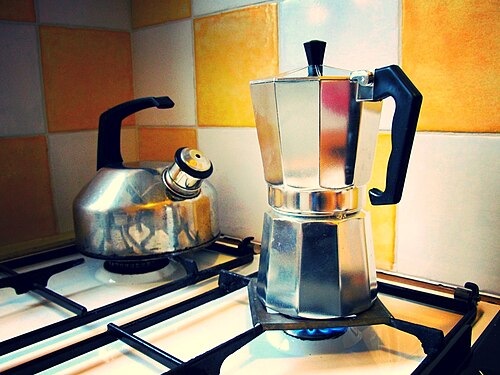

Begin at the water source
Find the filling step and trace the movement it requires. A removable tank may need to lift vertically; an attached reservoir may require enough room to open a lid and pour comfortably.
Measure that movement in your actual coffee corner, including the cabinet above it. The machine’s closed height does not tell you whether you can refill it without pulling it forward every morning.
Read the permitted water amount and any minimum batch requirement. For example, the Bonavita Enthusiast BVC2201TS manual gives a model-specific brewing range; it is not permission to treat every brewer’s cup markings or minimum fill as equivalent.
Use the manual’s defined cup measurement if one is supplied. Your favorite mug may hold a different amount, so turn the published capacity into the quantity you actually intend to serve rather than counting mug-shaped pictures.
Walk through the filter and grounds step
Identify the filter type, basket shape, and placement instructions. Note whether the brewer needs a particular paper filter, a reusable accessory, or an attachment included only with certain packages.
Check how you reach the basket and remove it afterward. A swing-out part, a lift-out basket, and a top-opening arrangement can create different demands on your available space.
Use the maker’s dosage guidance as a starting point for understanding the workflow, while keeping taste adjustments separate from the machine’s safe operating limits. Do not infer an unlimited fill level from a photograph of a generous mound of grounds.
Write down the consumables you would need to keep stocked. A filter that is easy for you to replace is a practical feature even if it is less exciting than an extra button on the control panel.
Read the carafe sequence carefully
Find the instructions for positioning the carafe, handling its lid, and removing it after brewing. A thermal carafe, a glass carafe, and their associated lids may have different operating and care requirements.
Check whether the manual’s setup and brewing sections agree about each step. If instructions conflict, ask the manufacturer for clarification rather than choosing whichever sentence supports your preferred routine.
The BVC2201TS manual is a reminder to read more than one section: its safeguards and operating instructions do not describe the carafe lid in exactly the same way. Resolve that kind of discrepancy with the maker before relying on a specific configuration.
Picture pouring at your normal serving location and returning the carafe afterward. A machine that fits under a cupboard can still be inconvenient if its handle, lid, or spout is difficult to use in your narrow station.
Distinguish useful settings from extra decisions
Read what each mode actually changes and how you activate it. A named feature may be a separate sequence, a saved preference, or a step you need to repeat whenever you start a batch.
For each control, ask whether it supports a real habit you want. If you make the same batch every morning, easy repetition may be more useful than several options you will not use.
If you want scheduled brewing, confirm the model’s documented behavior rather than assuming that a display means it has a timer. Read the preparation and safety instructions for the specific function you intend to use.
Avoid treating a function name as proof of better taste. The manual can tell you how a mode operates, but it does not establish that you will prefer its result in your kitchen.
Budget space for the whole cleanup
Find the daily cleaning and periodic maintenance sections. List the pieces you remove, the washing methods allowed for them, and any drying or reassembly steps that affect the next morning.
Compare the largest removable part with your sink and drying area. A wide basket or tall carafe can be manageable, but you should know where it will go before it arrives.
Look for model-specific descaling instructions and the approved materials or procedure. Do not transfer a vinegar recipe or cleaning cycle from an unrelated brewer merely because both machines make drip coffee.
Consider how you will remember periodic care. A calendar note and a readily available approved supply can be more useful than a complicated maintenance plan you already know you will postpone.
Read the safeguards before the purchase feels settled
Check requirements for the operating surface, electrical supply, clearances, and cord use. Compare those requirements with the actual position you have chosen rather than treating them as formalities after delivery.
Read the service instructions and what conditions mean you should stop using the appliance. Knowing the supported route for a damaged cord or malfunction is part of ownership, even though it should not dominate an ordinary buying comparison.
Check warranty and replacement-part information on the manufacturer’s current support pages. A carafe being removable does not establish that a compatible replacement will always be available or that every look-alike carafe is acceptable.
Keep unanswered safety or compatibility questions outside your list of personal preferences. A preferred color can be negotiable; an unresolved requirement for the intended installation needs an actual answer before operation.
Turn the reading into a one-page decision
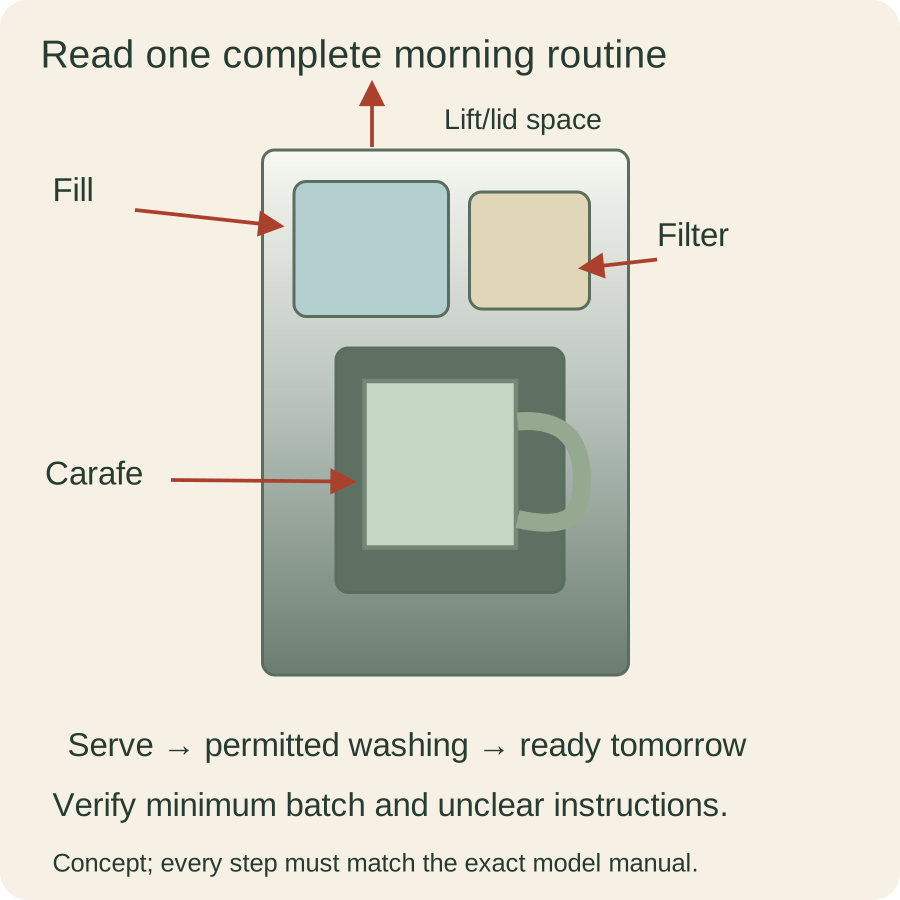
Write a brief morning sequence for each candidate: fill, filter, dose, position the carafe, start, serve, and clean. Add the open-lid height, supported batch range, consumables, and periodic care next to the steps they affect.
Circle the step that is most likely to annoy you in your kitchen. It could be lifting a tank beneath a low cabinet, washing a carafe in a shallow sink, or making more coffee than you normally drink.
Ask the maker a focused question for every important missing measurement or contradictory instruction. Keep the reply with the model record so your final decision rests on the same exact product you researched.
You can then compare brewers as usable routines rather than collections of feature names. The best manual-reading result is a clear picture of the morning you are buying, with enough practical detail to decide whether that picture suits you.
Check what arrives before the first brew
When you eventually order, compare the delivered model label and included components with the manual you saved. A different carafe bundle or a substituted regional version deserves clarification before you apply the routine you researched.
Use the maker’s first-use instructions, which may include preparation that differs from an ordinary morning’s brewing sequence. Reading before purchase gives you a buying decision, while reading again with the actual machine gives you the correct starting procedure.
Keep the packaging information and support reply until any mismatch is resolved. You should not need to improvise a missing accessory or assume that a look-alike part completes the intended setup.
Sources & research notes
Documentation checked October 22, 2026. Practical examples are original planning exercises; product recommendations compare documented features.