When you need exact ingredient weights, a grams-focused food scale is essential. This guide highlights five reliable options, explaining who each is best for, and why they stand out for gram-level accuracy. Whether you’re baking bread, portioning meals, or weighing spices, these scales simplify precise measurements and easy unit switching for American kitchens.
Product comparison at a glance
- Etekcity Food Kitchen Scale, 11 lb – Best for compact spaces and beginners
- GGQ Food Scale – Best for balanced capacity and multi-unit reads
- Ultrean Food Scale – Best for versatile unit options and convenience
- Greater Goods Digital Food Scale – Best for bulk cooking and large batches
- Yoncon Digital Scale – Best for portability and precision at small weights
Product 1: Etekcity Food Kitchen Scale, 11 lb

This compact scale weighs up to 11 lb (5 kg) with 1 g increments and supports multiple units, including oz, lb:oz, fl’oz, g, and mL. It includes a tare function for easy container subtraction and ships with two AAA batteries for immediate use. Best for: cooks and bakers who need reliable gram accuracy in a small footprint. Limitation: smaller capacity may require heavier batches to be weighed in batches for larger recipes.
Product 2: Food Scale 33 lb Digital Kitchen Scale (GGQ)
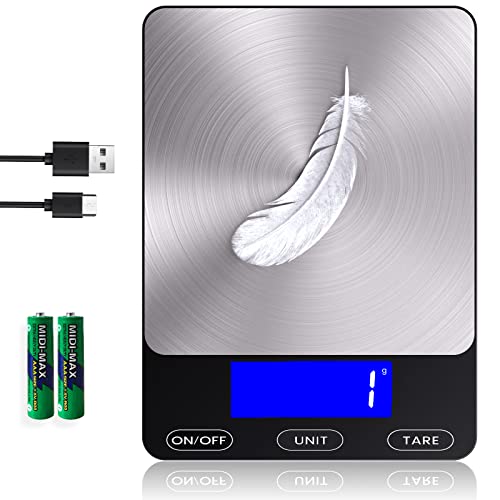
GGQ’s scale handles up to 33 lb (15 kg) with 1 g precision and includes four high-precision load sensors, a waterproof glass weighing panel, and six units (g, kg, lb, oz, oz, ml). Best for: meal preppers and families weighing larger quantities with consistent gram-level accuracy. Caution: a larger platform may take more counter space than smaller models.
Product 3: Ultrean Food Scale, 11 lb, Stainless Steel

Ultrean offers an 11 lb capacity with multiple readouts in grams and ounces, aided by a user-friendly LCD display and low-energy consumption. It supports g, kg, lb, oz, ml, and milk ml units, with a tare function for easy container subtraction. Best for: bakers and cooks who want a modern, stylish scale that covers common metric and culinary units. Limitation: some users report slower change readings with very light ingredients.
Product 4: Greater Goods Digital Food Scale

This high-capacity scale weighs up to 22 lb (10 kg) with 1 g precision and features a bright Hi-Def LCD display. It offers grams, ounces, lb:oz, and milliliters readings, plus a zero/tare function. Best for: serious bakers and bulk cooks who measure large batches with consistent gram precision. Caution: not designed for microgram lab-like accuracy or tiny quantities.
Product 5: Yoncon Digital Food Scale
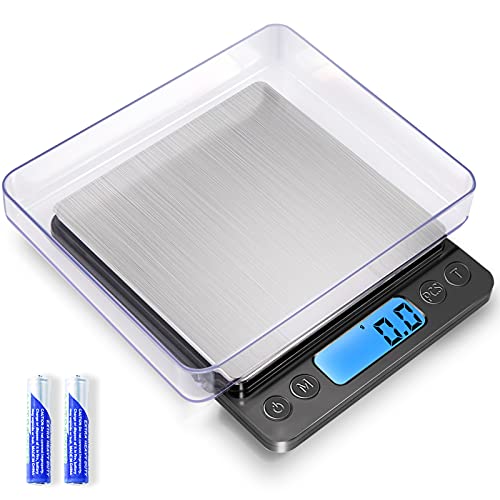
Yoncon provides 0.1 g precision over a 0.5 g to 3000 g range, with multiple units including g, oz, lb, tl, ozt, dwt, gn, ml. It’s compact for easy storage and includes a tare function. Best for: those who need precise gram-level readings at a very compact scale. Limitation: the 3000 g maximum may require multiple weigh-ins for very large batches.
Buying Guide: How to choose the right gram-focused food scale
- What capacity do you need? Select a scale that covers your typical batch size. If you regularly weigh small amounts, a 2–5 kg capacity is sufficient; for bread dough or bulk ingredients, a 10–15 kg scale is more practical.
- How precise should the readings be? For most recipes, 1 g increments are adequate. In specialized baking or scientific-like tasks, look for 0.1 g or similar micro-precision.
- Which units matter? Choose a model with grams, ounces, and milliliters if you work with both weight and volume in recipes.
- Is tare support important? A tare function lets you zero out containers, helping you measure ingredients directly in bowls or jars.
- Portability versus platform size? Smaller scales save counter space but may be harder to handle large bowls. Larger platforms stabilize bigger containers but take more room.
- Power and maintenance? Rechargeable or battery-powered scales offer flexibility; check if batteries are included and whether auto-shutoff features help extend life.
Frequently asked questions
- What does gram accuracy mean for baking? Gram accuracy helps ensure consistent ingredient weights, supporting repeatable results in recipes like bread and pastries.
- Should I choose a scale with a high capacity or a compact one? If you frequently weigh large batches, choose higher capacity; for small, precise measurements, a compact scale with 1 g increments is ideal.
- Do scales measure liquids accurately? Many scales can handle liquids, especially those with a waterproof or easy-to-clean surface, but check for a model with stable readings for liquid volumes.
- Is tare essential for cooking? Yes, tare allows you to weigh ingredients without including the container’s weight, improving accuracy and convenience.
- Can I rely on these scales for nutrition tracking? Yes, gram-based measurements align well with nutrition databases, aiding precise ingredient tracking.
- Are there hidden costs? Some models require micro-USB or USB-C charging, while others run on included batteries; check what’s included before purchasing.
| Product | Best For | Key Gram Feature | Capacity |
|---|---|---|---|
| Etekcity 11 lb | Compact kitchens, beginners | 1 g increments | 11 lb / 5 kg |
| GGQ 33 lb | Bulk cooking, larger batches | 1 g increments | 33 lb / 15 kg |
| Ultrean 11 lb | Versatile units, stylish design | Multiple units, MIL-friendly | 11 lb / 5 kg |
| Greater Goods 22 lb | Bread, bulk baking | 1 g precision | 22 lb / 10 kg |
| Yoncon 3000 g | Compact and precise | 0.1 g precision | 0.5 g – 3000 g |